On Sunday 18th January 2026, the Islamic Human Rights Commission (IHRC) hosted its seventeenth annual Genocide Memorial Day (GMD) at the P21 Gallery in London. This year’s theme was “Genocide: How did we get here”, which focused on the ongoing genocide in Gaza.
The genocide in Gaza is an object lesson in the failure of genocide prevention. Just like Rwanda, Bosnia and Myanmar before it, it is an agonising reminder of the limitations of the international political order in restraining humanity’s propensity to evil.
Watch the event here, or read the report below the video.
It is not that we don’t possess the tools to avert the industrial-scale slaughter of humans: the legal and political architecture to protect people and punish perpetrators has been in place for many decades. Rather, the wilful abandonment or selective application of anti-genocide principles routinely produces new horrors such as the one we are witnessing in Gaza today.
Gaza has laid bare the hypocrisy of a system that preaches human rights, chief of which is the right to life, but which fails to take the steps necessary to ensure them and worse still, allows nations to violate them with impunity. The global refrain, “Never Again”, has been reduced to a sardonic epitaph etched with blood into the rubbled remains of Gaza.
And even as the roll call of massacred innocents grows, existing memorials such as Holocaust Memorial Day work tirelessly to obfuscate and deny the reality, going as far as to exclude remembrance of the genocide in Gaza. In doing so, they expose their moral bankruptcy and complicity, rendering themselves unfit for purpose. If we fail to recognise Gaza as a site of genocide, we remain silent in the face of profound injustice. Such silence affords Israel moral and political cover to continue committing war crimes.
This is where Genocide Memorial Day comes in. It upholds the sanctity of all human life, irrespective of ethnicity, religion or political conviction. It disavows, unequivocally, the unjustified killing of fellow human beings. All human life has equal value: there is no scale of human suffering by which any one genocide should rank higher than others.
The event began with the recitation of verses from An Nisa of the Qur’an, followed by a presentation by Raza Kazim from the Islamic Human Rights Commission (IHRC). He opened up the event with a speech that explained the history of settler colonialism and its relationship with the act of genocide. He went on to explain how he remembered how, in previous GMDs, experts such as Prof Ilan Pappe said that this genocide would go on for years and that this is exactly what we are seeing now. The idea of memoricide (the forgetting of certain genocides) played a central theme in Raza’s speech as he stated how the former Secretary of State Mike Pompeo said that when it comes to the issue of Gaza, what is important to remember is that the victims of the genocide were the Israeli’s and not the Palestinians. This is exactly one of the missions of IHRC’s GMD project, which was set up in 2010 with the sole aim of stopping genocides and genocidal acts. He went on to explain when GMD happens and how the act of remembrance plays an active role in order to help the new generation learn the warning signs of genocide. The 3rd Sunday of January was chosen as the day in order to commemorate the end of Israel’s operation Cast Lead, which occurred in 2009. “IHRC started GMD in order to challenge the hierarchy of victim as well as to say to the powers of the world that we are going to hold this event on the anniversary of the end of the operation Cast Lead as a genocide, which was a genocidal act that was committed by the Tel Aviv regime against the Palestinian people”, he said. Raza emphasised that it is not enough to commemorate the genocides of the past if we cannot or are unwilling to challenge the genocides of today. GMD rejects the notion that there is a hierarchy of victims by highlighting the people and power structures that are responsible for genocides and genocidal acts. IHRC wants to hold those responsible to account, as well as to remember the victims of genocides and genocidal acts. The GMD is influenced by Islamic thinking; however, Raza was clear that the event was inclusive of everyone and encouraged everyone to take part. Raza strongly emphasized that the GMD will seek to challenge this notion of selective remembrance especially in Britain, which only remembers certain genocides, and not the one’s the Britain has participated in, due to its own political interests. GMD is here to ensure that we remember all genocides and that we remember all of the victims. Due to the Holocaust Memorial Day (HMD) not recognising the genocide in Gaza, IHRC strongly advised everyone to boycott all HMD related events and take part in alternative events instead.
GMD is here to counter memoricide and to ensure that all genocides are remembered and that we learn lessons from them.
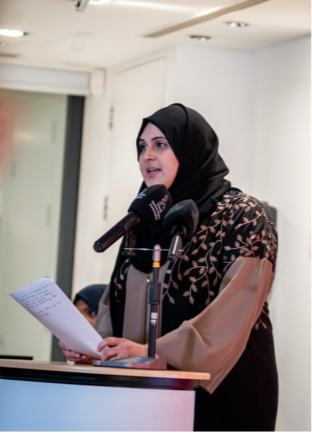
Fatima Merchant, the chair of the event, introduced the first speaker.
Session One
Professor Haim Bresheeth-Zabner
Bio: He is an academic, an ex-Israeli Jew who has been active for over five decades as a socialist, anti-Zionist and anti-racist activist. His parents were both Auschwitz survivors who came from Poland. His mother was freed by the British forces in Bergen-Belsen, and his father was freed by the US forces in Mauthausen. He was born in a Displaced Persons Camp in Italy, and arrived in Israel as a baby in June 1948, as no European country would then accept Holocaust survivors.
He is an outspoken critic of Zionism and advocates for Palestinian rights, which is rooted in his personal life. His critical analysis of Israeli society is presented in his academic work, emphasising that Israeli society must be decolonised and freed from the Zionist project, its injustices, institutions, and racist privileges.
As a filmmaker, photographer, and scholar of film studies, he also served as a Professorial Research Associate at SOAS, University of London. He has produced engaging films including ‘State of Danger’, ‘London is Burning’, and ‘Convivencia at the Turnpike’. His ongoing academic and activist work includes books such as ‘Introduction to the Holocaust’, ‘The Gulf War and the New World Order’, and ‘The Conflict and Contemporary Visual Culture in Palestine and Israel’. In his most recent book, titled ‘An Army Like No Other: How the Israel Defence Forces Made a Nation’ argues that the Israeli military is not just a defence force, but the central institution that has fundamentally shaped Israel’s national identity, economy, and social structure through a lens of perpetual settler-colonial conflict.
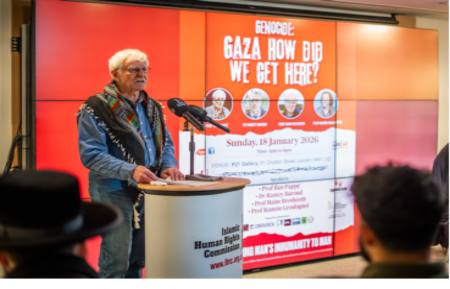
In November 2024, during an anti-genocide protest, he was arrested for a speech in which he slammed Israel for its colonialism, racism and violence, including the mass murder of civilians.
Haim explained how he believes that most of the organisations that run Holocaust memorials are run by Zionists and that he went on to the websites of all of those organisations to see which one’s recognise the genocide in Gaza to which he stated that there was “none.” According to Haim, we must look into the dismantling of the international rules-based order, which was unmasked thanks to the genocide in Gaza. He said that those who are responsible for the genocide will not face justice, no matter how much is uncovered, especially when he said, “The more we learn, the clearer there is an informational darkness around us.”
There are new technologies, alongside the mainstream media, that assist the powerful in ensuring that they get away with the heinous crimes they commit. Haim said that there is a new form of capitalism, which connects technology, AI, and cryptocurrency, which has merged with the ideology of Zionism, creating conditions to inflict maximum pain. Haim calls them the “Western chaos engine.” He then explained the special features of this ongoing genocide as being “The most public, technological, televised, shared global genocide which has never happened before. This is the most sadistic, traumatic genocide,” He finished his talk by saying how the UN and other institutions failed in stopping the genocide in Gaza, subtly emphasising the fact that these institutions are part of the problem, not the solution. However, according to Haim, Zionism is losing the narrative, and we must make sure that the Palestinians win – because if they lose, then we all do.
Haim’s speech emphasised the point that the genocide in Gaza played a central role in unmasking the destruction of the rules-based order and that we must stand in solidarity with the Palestinians in order to stand up for international law.
Professor Ilan Pappe
Bio: Professor Ilan Pappé is a renowned historian, political scientist, and academic recognised for his anti-Zionist activism. He moved to England to study history at the University of Oxford, earning a PhD in 1984. His doctoral thesis was titled ‘British foreign policy towards the Middle East, 1948-1951: Britain and the Arab-Israeli conflict’. He became well known as one of Israel’s “New Historians”, using declassified archives to highlight Palestinian suffering, re-examine the history of Israel’s founding, the Israeli-Palestinian conflict, and challenge the Zionist narrative. Currently, he is a professor at the College of Social Sciences and International Studies at the University of Exeter in the UK, director of the university’s European Centre for Palestine Studies, and co-director of the Exeter Centre for Ethno-Political Studies. He taught at Haifa University and left Israel in 2007 due to political pressure. He is the author of numerous books, including ‘Britain and the Arab-Israeli Conflict’, ‘Ten Myths About Israel’, ‘The Ethnic Cleansing of Palestine’, ‘The Modern Middle East’, ‘A History of Modern Palestine: One Land, Two Peoples’, and ‘Lobbying for Zionism on Both Sides of the Atlantic’. In his latest academic work titled ‘Israel on the Brink: Eight Steps for a Better Future’, he argues that internal political fractures and the recent escalation of conflict signal the collapse of the Zionist project. He paves a path out of the Jewish state, rooted in restorative justice and decolonisation, including the return of refugees, the end of illegal settlements, and building bridges with the Arab world.
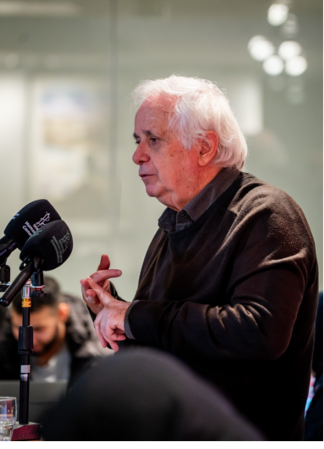
Ilan began his talk by explaining the age of extremes, which begins with the age of catastrophe. He stated that Zionism was born not only in the age of extremes but also during the age of catastrophe. The catastrophe he refers to involves acts of genocide that the West participated in against the peoples of the global South, which influenced Hitler. While Europe was experiencing a catastrophe, Palestine at that time was going through the opposite, as it was beginning to become prosperous. However, Gaza had to accommodate the refugees created in 1948, despite lacking the infrastructure to do so. Ilan states that by 1948, Europe had begun to recover from its catastrophe, but what catastrophe was Europe experiencing? Europe’s catastrophe was antisemitism, a form of racism against other Europeans. Instead of learning from this and stopping it, Europe projected its catastrophe onto the Palestinians. This genocide is very much a Western European project, and although there are extreme religious forms, the greatest form of extremism was Western colonialism. Nevertheless, Ilan highlights that Netanyahu’s religious advisers believe that what Israel is doing is a miracle, a sign from God. The genocidal state is founded on an ideological foundation, with its practices on the ground and that any form of alternative MP’s had no different vision where Palestinians were concerned.
In his speech, Ilan explained how the definition of extremism has been reinterpreted to mean religious extremism, although in reality, states can also commit acts of extremism. He pointed out that Zionism emerged due to Europe’s disastrous relationship with antisemitism. This indicated that Europe failed to learn the lessons of the Holocaust and instead exported its genocidal tendencies to Palestine.
Dr Ramzy Baroud
Bio: Dr Baroud is a Palestinian-American journalist, media consultant, author, international columnist, and academic whose activist work focuses on Palestinian resistance in the struggle for human rights and a single democratic state.
Ramzy holds a PhD in Palestine Studies from the University of Exeter and has been a guest speaker at universities worldwide. He was a Non-Resident Scholar at the Orfalea Centre for Global and International Studies at the University of California, Santa Barbara. He is currently a Non-Resident Senior Research Fellow at the Centre for Islam and Global Affairs (CIGA) at Istanbul Zaim University (IZU).
He is the Editor of Palestine Chronicle, former Managing Editor of the London-based Middle East Eye, former Editor-in-Chief of The Brunei Times, and former Deputy Managing Editor of Al Jazeera Online. He is also a regular guest on numerous television and radio programs, including TRT, Al Jazeera, CNN International, BBC, ABC Australia, NPR, Press TV, and many other stations.
Baroud’s books include ‘Searching Jenin: Eyewitness Accounts of the Israeli Invasion’, The Second Palestinian Intifada: A Chronicle of a People’s Struggle, ‘My Father Was a Freedom Fighter: Gaza’s Untold Story’, ‘These Chains Will Be Broken: Palestinian Stories of Struggle and Defiance in Israeli Prisons’. He co-edited with the renowned historian Ilan Pappé, the book ‘Our Vision for Liberation: Engaged Palestinian Leaders and Intellectuals Speak Out,’ in which the core theme is that Palestinians should be the primary architects of their own liberation and political destiny. Next month, his recent work titled ‘Before the Flood: A Gaza Family Memoir Across Three Generations’ will be published.
In late 2025, Baroud participated in the Gaza Tribunal in Istanbul, providing expert testimony on the history of Palestinian resistance and the legal frameworks surrounding the right to resist occupation.
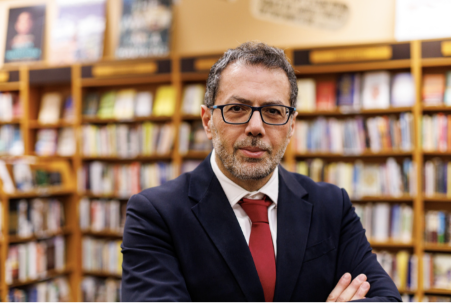
Ramzy began his lecture on the dehumanisation and hatred towards Palestinians by comparing the Rwandan genocide with the dehumanisation of Palestinians. “The Rwanda massacre and genocide occurred in the early nineteen nineties, decades after Israel and Zionism created and perfected the dehumanising discourse of Palestinians. He explained that genocide does not start with physical killing but with language: language as a weapon and a mechanism of dehumanisation.
He addressed how Western media continue to deliberately miss the context. The idea that Israel is never in a state of aggression is familiar. When media coverage focuses on what Israel has done, you will find that mainstream media has always absolved Israel. If we look at any period of Israeli history and examine the political discourse from Israeli officials, including Israeli institutions and intellectuals, the same conclusion emerges: Israel has always built a narrative of incitement and hatred that continually makes a case for the genocide of the Palestinians.
He asked the audience to reflect on what happened between 1948 and October 7, 2023, and what occurred even before the Nakba, before the very destruction of the Palestinian homeland. As he said, “this is where the selective nature of the West comes into play”. Israel is able to segment its own history so that everything prior to 7 October 2023 becomes irrelevant. We must not allow Israel to segment history and give Israel the space to reinvent history. He concluded by saying that “the mistake we might have made is not succeeding in telling the world or conveying to the world that Israel’s genocidal intentions have existed from the very beginning, in fact from the very creation of the Zionist movement”.
Anika Dawood
Bio: Anika is a writer, poet and Politics and History graduate at SOAS and currently a postgraduate student at King’s College London. Based in London, Anika hosts poetry nights, exhibitions, and workshops. In her poetry, Anika explores themes of social injustice and cultural identity through her experiences, while amplifying silenced voices from marginalised communities.
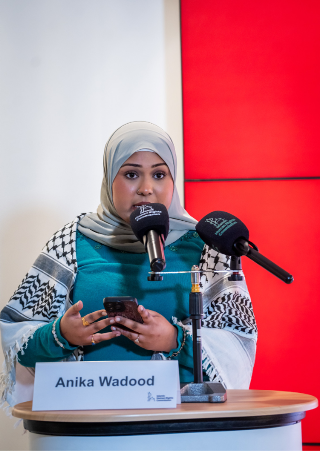
She read her own poem titled ‘The Water Drips from My Leaky Ceiling’. The poem by Anika Dawood is a powerful spoken-word piece that reflects on the horrifying reality of the suffering in Gaza and Palestine.
The water drips from my leaky ceiling
It’s been like this for days
The raindrops softly trickles down my wall as I hear the thunder rage
She hisses with icy tones, Gail force is furious,
I wonder why she’s angry? my mind is curious
I hear her loud and clear from the warmth of my home
She’s telling us that the people of Palestine no longer have theirs and are left out in the cold to roam
Snatched and stolen, the truth is it happens all the time
Whilst Israel sits comfortable on a mountain of bodies and hefty crimes
In Gaza there’s a storm brewing outside
But there’s nowhere for the children to hide
Their existence is denied in the midst of this evil genocide
The hurricane rages like never before
They don’t know what’s next in store
You claim that this is a war but one side consists of rubble and ruins that the other side chooses to ignore
And That ignorance is a heavy sigh of bliss
The horrors pile up, that you witness on every single screen and yet you still choose to dismiss
You hear the jeers and cackles of this malevolent storm,
Thrashing and smashing the land day and night, this is Gaza’s norm
when will it surpass? When will it go still?
The answer is when every single civilian is killed.
I see the water seeping, drop by drop,
But this time it’s down my cheeks, I don’t think it will ever stop
My face will be dry when they hear silence at long last
But that doesn’t change the fact that there were lives lost so fast
Not just lives but limbs are scattered across the ground like the leaves at the end of autumn
We know why Gaza became a graveyard, no need for a post mortem
Families erased from the paper because there’s no one else left
They were robbed of a future, what a heinous theft
I close my eyes in the midst of the heaviest rainfall and pray
That every single Palestinian soul drifts to the highest of heavens, a home for their spirits to stay
And that those who are still breathing on this land can live to see another day
As the rainfall pours down from the skies
It mirrors our, tears, it mirrors our cries
in the millions in the billions
We yearn and cry for our Palestinians
You hear its fury brandishing the ground
Mirroring our thundering rage, a true warrior sound
We are angry, because of their crimes, and as the water gushes, drenching our clothes
the number of fallen men women and children forever grows
every raindrop is every tear shed by the mothers and fathers witnessing the death of their child,
the scared children alone and afraid, when was the last time they smiled?
Born into a world permeated with a looming darkness
the people from above will never let the light shine They don’t care about the distress
Or the death in excess
But They will never confess
Because they see money in their eyes, a barren land is their success
And they will continue to oppress
Whilst they profess, they will stop all the protests
They Paint us as the wrong side
Extremist and terrorist, their favourite words, they’re laughing behind their lies
It’s important that we defy
And Cut the ties
If you want to stop hearing those withering cries
Before any more of them die.
My eyes have sorrow, my heart thumps with anguish.
My mind makes a wish for the enemies to be vanquished
I see red, scarlet pools of blood drowning the rivers
Bubbling the fervour coursing through my veins, my whole body shivers
My lungs put out with seething screams as we demand the justice for our brothers and sisters
The justice that they have locked up in their towers of terror guarded with snakes who whisper
Whispering lies
Remember that among us are their spies
They allow the enemies boots to stampede onto Palestinian land
But we will March on, through the streets to demand
Demand for freedom, demand for justice, demand for it all to end
We are each raindrop striking the ground all at once, in order to defend
Its sound is great, it’s bold it terrifies you
Because we know that the Palestinians are terrified too
Left in the dark
The wetness on their face
The withered screams becoming so silent that you know longer sense a trace
And that is because they are tired
Tired of the misery
Tired of the terror
Tired of the death,
Tired of the destruction
Because this has become their norm
This everlasting storm.
So we take their tears, we cry for them
We take their screams and we yell for them
We take their hand and hold it high for them
We eradicate their darkness, turning the light on for them
From across the river and to the edge of the sea
we know that Palestine will be free
Session Two
The second session consisted of lecture by Prof Ramon Grosfoguel.
Professor Ramon Grosfoguel
Bio: He is a distinguished scholar, a professor at the Department of Ethnic Studies at the University of California, Berkeley, an activist, and a critical theorist renowned for his work in decolonial studies, sociology, international migration, and the political economy of the world-system. He has been a research associate at the Maison des Science de l’Homme in Paris for many years.
His research critically explores the intersections of race, gender, class, and power within the frameworks of Western capitalist modernity. His scholarly contributions enable intellectual debate on how colonial histories shape current social, political, and economic systems worldwide. He has written numerous works on the historical and epistemological foundations of colonialism and imperialism. His research critically assesses how Eurocentric knowledge paradigms perpetuate racialised systems of dominance and inequality, emphasising the interconnectedness of capitalism and colonialism on a global scale and demonstrating how modernity remains fundamentally linked to colonial encounters.
Ramon is currently producing recorded lecture series and is a regular guest on numerous television and radio programmes. His scholarship has influenced scholars and activists worldwide, challenging conventional narratives and offering alternatives for decolonising knowledge, society, and power. His contributions are crucial to contemporary discussions of racial justice, global inequality, and the legacies of colonialism.
Ramon began his speech by stating that everything he would cover had already been mentioned in previous GMDs. The first point he made was that settler colonialism was inherently genocidal. He says this because settler colonialism inherently aims to displace the native population. He mentioned that a long history of different forms of settler colonialism has led to genocide. But according to him, this genocide is different because it was a slow form of genocide, where the genocidaires relied on the labour of the natives. Ramon describes this as exploitation genocide. He explained that within the minds and thinking of the colonisers, there is a thinking that dehumanises the natives, which is a factor when it comes to genocide. The issue with previous genocides and Hitler’s genocide is that if Hitler had carried out his actions in the global south, he would have been viewed as a normal world leader. However, what sets Hitler apart is that he conquered neighbouring European states. Today, however, Western imperialism’s toleration and acceptance of Zionism have become the mechanisms through which fascist, undemocratic leaders are now emerging. This process is exposing the flaws in the rules-based order and International Human Rights, despite Zionism continually violating these laws with the tacit support and complicity of the West. The international order was shattered in Gaza in the most dramatic way, creating a situation characterised by chaos. Ramon stated that, although in the past the West pretended to follow International Law, now there is no such pretence, leading to a terminal crisis for the US empire. The Zionist project plays a central role in the rise of fascism, as there is funding from Zionist sources supporting right-wing European initiatives. However, Zionist movements also require a form of material support, which remains their fundamental weakness. This is why Israelis have perfected the method of selling technologies of occupation, turning Palestine into a laboratory — a reality that also explains why the world has tolerated Israel’s occupation: because this is how Israel has secured support from Western states.
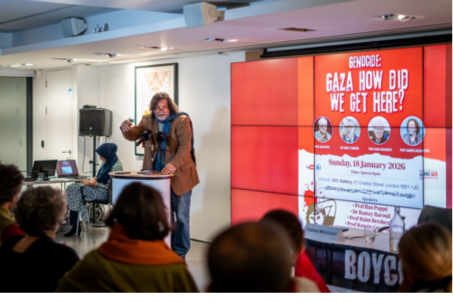
He explained the centrality of the Zionist project in preserving and giving rise to the ultra-nationalist right-wing parties in Europe, which partially explains its success. Zionism is playing a key role in the destruction of this rules based order.
The chair of the event, Fatima Merchant, opened up the floor for Q&A, which covered all topics related to the issue of genocide in Gaza and the future of Palestine. Below are some of the questions attendees ask the speakers’ panel.
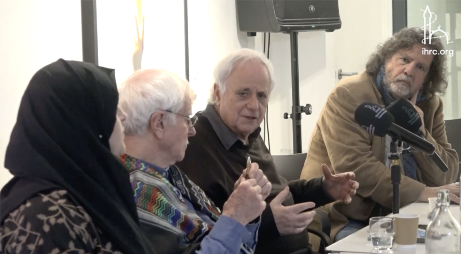
Questions & Answers
What can we do to ensure that this is the end of Imperialism?
Ramon: There are contesting projects here because the Western elites are split between the old fascists and the Davos elite, who have different projects. He stated that the new form of imperialism, the Davos elite, is worse than the older forms of imperialism. There is a consensus that a major collapse is imminent, but what is happening with the Davos elite who are causing something worse? What is the alternative to that? He believes that this is creating an opportunity for people to embrace change. What’s the weakest link of the imperialist chain? Since the English were the first in, are they going to be the first out? What is the way forward now that there is no international law? Islamic liberation theology and Iran is the only power against the imperialism of the West
Ilan: Ilan states that we are not talking about days but rather the end of a period, which can be very wrong. This means that activists have time to strategise and prioritise goals. Strategising involves working with people who share your worldview, but there is a sense of urgency. He doesn’t believe that England would be the last, but it is important to explain the context and Britain’s role in imperialism, which explains where extremism begins. Iran is not the only country against Western imperialism. This view is unfair towards the countries of the global south. Ramon: He was in Venezuela on the ground in 2017, and the imperialist forces brought in paramilitary forces that started killing people in the street, which made people afraid to walk in the streets. When he took the aeroplane outside of Venezuela, the press said that Maduro was killing his own people in the streets. They do this to make sure that the Western media reports that the regime is killing people in the streets. This is why we need to be careful about how we judge the events in Iran
Protests in Britain and Israel? Are the Israeli’s waking up or changing their hearts?
Haim: The most dangerous time for the experience of an empire is when it’s going out because they know they’re going out. UK, England: The UK is beyond saving. There is nothing we can do to save the rotten elites of the UK. Please do not believe that any change will come from the people of Israel, it will not come. Iran is not a perfect country, but Iran has not attacked anyone. Haim believes that it is not up to the West to lecture anyone on how they should live their lives.
Before the event concluded, Fatima, the event chair, took a moment to mention various genocides that have occurred around the world. This was followed by a one-minute silence to remember those who lost their lives. While this segment has become a cherished tradition, hearing it each year still deeply resonates and reminds us of the importance of remembrance.
Fatima introduced Massoud Shadjareh, the chairman of IHRC, who concluded the event by expressing heartfelt gratitude to the panellists for their inspiring speeches and to colleagues and friends who stand for justice. He mentioned that seventeen years ago, GMD was established, and the core message was that genocide is the worst crime that man can commit. He stated, “man’s inhumanity to man needs to be addressed at all levels. There is no hierarchical structure to that.” Massoud highlighted that the international community has done nothing about the ongoing genocide in Gaza. Finally, he told all attendees of the event, both in person and online, that “if we do not stand on the right side of history, then we will be answerable for the legitimisation of genocide becoming a tool for oppressors”.
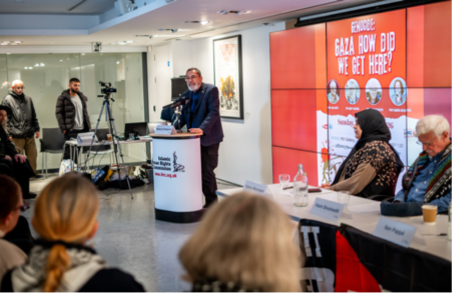
The Genocide Memorial Day events have taken place this year in Switzerland, Malaysia, Mexico and UK.
You can find an album of photos from the day here and below.