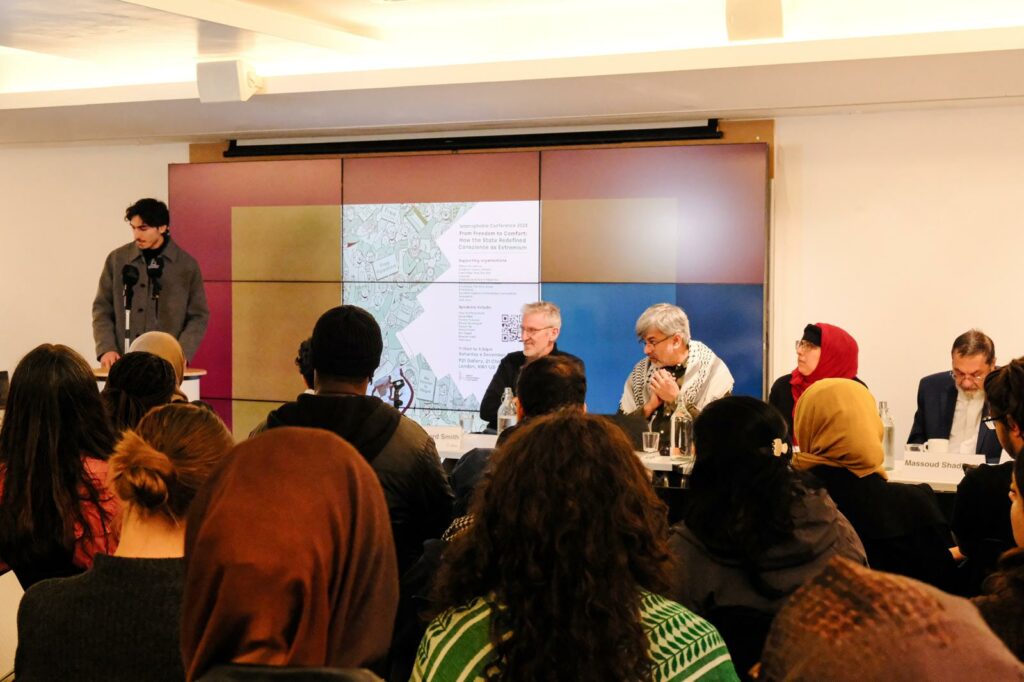
IHRC held the 12th annual Islamophobia Conference on Saturday 6th December. Entitled From Freedom to Comfort: How the State Redefined Conscience as Extremism’, the conference explored how consciousness has become criminalised and delegitimised.
Professor Saeed Khan’s paper ‘When Conscience Becomes Crime: The Vacuous Charge of Extremism for Advocates and Activists’ provides a background to the topic. His paper argues that opponents and dissidents have long been charged as extremists. You can read his paper in The Long View.
The conference took place both online and in-person. You can catch up now on YouTube.
Contents
Live Stream
Professor Saeed Khan introduced the conference and spoke through how “what we really can say that distinguishes us from AI is having a conscience. And yet at the very same time, right now, having a conscience, the building block and the essence of what makes us human is being challenged by the states and by corporations and by others as a form of extremism.
Now I always thought that having a conscience was always a part of the hard wiring. In the old days it would be considered standard equipment on a car, not something that you would have to pay for as an option. But here we are, the idea that whether it is on a university campus, whether it is on a public street, whether it is at the workplace and in some cases even within one’s household, you will find that having a conscience, wanting to speak out for other human beings or other causes that affect human beings, is seen as an act of extremism, is seen as an act of heresy.”
Panel 1: Deconditioning: Testimonies from the Margins
The first panel was chaired by Raza Kazim and the keynote speaker was Clive Stafford Smith.
Clive Stafford Smith began his presentation by speaking on his early experiences as a lawyer who focused on African American prisoners on death row. He then got involved in cases at the notorious Guantanamo Bay where inmates faced the death penalty.
“When you’re talking to Americans, you talk the religion of Christianity, you talk about the New Testament. You don’t want them to impose the death penalty, you say Mattew Chapter 5 Verse 7, ‘Blessed are the merciful, for they shall obtain mercy.’
Because t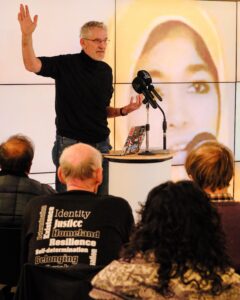 he issue in a death penalty case is ‘is this group of jurors, all of whom have sworn up and down they believe in the death penalty, are they going to kill my client?’ And, the language, if I speak to them in a language of my lefty political attitudes and the ACLU, I’m just gonna insult them. Whereas if I tell them, in Matthew Chapter 5 Verse 7, this is not about what my client did, this is about whether you want to go to heaven or hell. And the prosecutor wants you to show no mercy. I’m sorry but that means eternal damnation. That if you want to go to heaven you do what I ask which is show mercy to the person I’m representing.”
Clive then went on to speak about the case of Aafia Siddiqui, one of his clients who was abducted by the ISI and CIA in March 2003. He spoke through her case and experiences, showing through his presentation how she not only she has been tortured but also how her children were also abducted and mistreated.
Clive has also previously spoken at an IHRC author evening about Aafia’s case, you can watch it here.
We then heard from Fahad Ansari who spoke about his experience of political cases in the courtroom. He spoke about Clive’s work to humanise and publicise those freed from Guantanamo Bay as a key element of their freedom.
“Within Britain, the British legal establishment are very conservative. Even the lefty lawyers, they like to do things, very conservatively speaking. For example, in my own cases, my own judicial review against the British government and the police force for stopping me under Schedule 7 in August this year and taking my work phone and taking access to all the data on the cases I am taking against the British state. So, they’ve got a keen interest in accessing this phone.
And I’m in a constant battle with my lawyers about getting the judge’s back up. Well, the judge isn’t really there to help me. He is already siding with the government so often. And this very judge, for example, just to give you context, 20 years ago he was a special advocate.
For those of you who are not aware, in Britain we operate a secret court system. So, in political cases, cases of political violence, so-called terrorism cases, the government allows the court to have a secret court. In this shadowy building, which is in a basement just for effect, you are not allowed to see a large part of the evidence against you. Your lawyers are not allowed to see that evidence against you. So, what they do is to try to mitigate the unfairness, they give you a security vetted barrister.”
Fahad then went on to speak about the procedures of the secret court system and his experience with them in his case. He says the courtroom is not where political battles are won, they are won outside of the courtroom and system.
Zareen Taj then began her speech responding to hate populism that Clive spoke about in his panel essay which has trickled down from above to the masses. She spoke of the need to push back against the ‘hate populism’ that blames migrants. Zareen also remarked about her involvement in bringing Aafia’s case to Edinburgh.
“Cambridge, where I am based at the moment, is an ideal place because they operate through the university. It’s the infrastructure that feeds our leaders in Parliament, in the big companies, the CEO’s. They come from Oxbridge.
So, the students, when they made their encampments in support of Columbia university students, they were really up against the worst establishment of people because where is the in-road to dismantle this system in the university which is actually feeding the Boris Johnsons of the world? And then along comes Keir Starmer who doesn’t seem to fit any of that stuff.
So, the work that was done prior or 2023 by the students, supported by Stop The War, led to all the knowledge that the students needed to pick the targets of the university where the arms companies were coming in and infiltrating. And now also we have this wonderful group called ‘Cambridge Institute for Sustainable Leadership’. But actually, it’s all Anglo-Americans that are funding it. So, it’s all green hypocrisy.
One thing that we haven’t mentioned when we’re talking about Islamophobia is the climate crisis that we’re suffering at the moment. A lot of decisions are going to be made and a lot of decisions are made to try and mitigate the climate crisis. And, changing to renewables just means that there’s this green capitalism, still these colonial ideas of going into an area and stopping mining fossil fuels but mining minerals for batteries. In doing that they’re displacing the indigenous peoples and polluting the water and polluting the air.
So, we’re the people who are then suffering, they’re made refugees in war zones for all of these resources. Fighting for resources gives us war which gives us refugees and then we’ve got this crisis in this country where people think ‘we’re being flooded by refugees, flooded by asylum seekers, migrants are taking our jobs.’ So we have got to push back against all of these things and Muslims seem to be at the intersection of all of those things. The global south countries are being affected by all of those wars, Muslims work in the NHS. If you are a GP, you’re supposed to report your patient if they’re showing signs of radicalisation. If you’re a patient you don’t know if you’re going to be targeted.”
Zareen then went on to speak about issues around Prevent and how Muslims have been on the receiving end. The normalisation of how Muslims have been targeted has become increasingly exposed as the movement for Palestine grows to connect to the climate crisis movement.
We then heard from Massoud Shadjareh who spoke about the link tying the case of Aafia, Guantanamo Bay and the current state of politics. Islamophobia a is tool used to demonise much of the community to allow individuals to get away with murder and indeed war.
“Some of the tortures are indeed worse than murder. And they are getting away with it. We are seeing this being implemented so precisely, so affectively, so institutionally that its frightening. Governments are involved in it, and it’s not just Western governments, it is actually many Muslim governments that are party to that. And it’s something that legitimises putting people against one another, divide and rule.
And we saw at Brexit how effective it is to divide people, blame a section of the community and then mobilise everyone else and use those tactics. This is exactly the tactic which was used by Nazi Germany in mobilising and becoming populist. We are seeing populism, the same policy used by the extreme right, right now in this country and elsewhere.
This is the danger. When we are seeing that donkeys and dogs are being airlifted out of Gaza, out of Afghanistan and people are left, children are left to die and be massacred. Our conscience needs to waken.”
Massoud then went on to speak about how IHRC has been ringing the alarm bells for a very long time about the Environment of Hate. He questioned why our governments are promoting the environment of hate to the extent that it is affecting all of us as the lack of humanity for Gaza, Afghanistan, Guantanamo, Aafia and other issues demonstrates.
He said we need to listen to our conscience, t challenge this narrative and otherisations. Islamophobia has been going on for a very long time and we need to challenge the environment of hate and the media and politicians who promote it. We must look at humanity as equals, and in order to confront this otherisation we must stand shoulder to shoulder.
There was then a Q&A session that allowed participants in the audience to engage in discussions with out panellists.
Panel 2: Academic Amnesia: Universities, Surveillance, and the Sanitization of Truth
The second panel was chaired by Kaneez Hisbani and the keynote speaker was David Miller.
David Miller began his keynote speech by speaking about the wider material context and aims of liberation and decolonisation. He also spoke about the negative effects of Zionism in the UK and the need to end it not just for the Palestinians but for everyone. To end Zionism is part of ending Islamophobia.
“In a way we’re winning. We are winning the legal debate. In the last few weeks, as everyone would have noticed. Anti-Zionists have won case after case in the courts. In the teeth of their own fear that they were going to get sent away. Like Natalie Strecker in Jersey, she thought she was going to get 10 years. She was not guilty. In many other cases, that’s been the case. And that’s going be the trend.
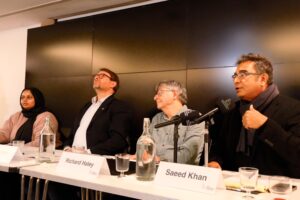
But we cannot rest on our laurels because we have mostly been fighting defensive campaigns and we need to start fighting offensive campaigns against the Zionists to try and take apart the Zionist movement.”
Miller then began to conclude by drawing attention to the IHRA definition of antisemitism and its reach in policing, but also academia, which he referred to it as being a “Zionist regime definition”. The definition attempts to define hate crimes against Jews “in a manner which is systematically biased”. Miller then goes on the state examples of how the overreach of what is defined as anti-Semitism has in reality been targeting pro-Palestinian activism.
We then heard from Richard Haley, chair of Scotland Against Criminalising Communities. SACC is a supporting organisation of the Islamophobia Conference and co-hosted this year’s Scotland Islamophobia Conference.
Richard spoke about how universities are run and ruled by the ruling class and how those who work for universities experience privileges. As more people enter university, not of the ruling class, academic freedom has grown and should be defended as freedoms are pitted against the ruling class.
“And what we are fighting for here is nothing less than a U-turn in the policy, not just in the present government, but of the state and of all the institutions that affects society. That’s what we are up against. We shouldn’t be surprised, we shouldn’t feel that we are not fighting hard enough if we encounter some difficulties.
Why is the ruling class here so committed to Israel? Well, its partly because Israel is incidentally a Jewish colony but above all a European colony. As such, it benefits from a sort of subjective affinity, our ruling class feels for it, and above all its geopolitical and European and economic usefulness as that kind of outpost in West Asia.”
Richard went on to speak about the public opposition to Israel despite the censorships. Confrontation becomes inevitable and the academy aligns with the ruling class and its interests.
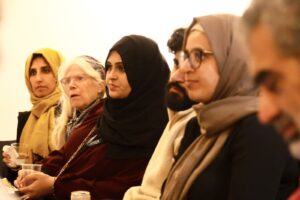 Saeed Khan then began his response with a historical approach. “History from the standpoint of causation, history from the standpoint of lessons to be learned and also looking at what is the, and the new generation lives this term, what is the meta? Where do we need to look at some of these issues? Do we locate them as symptomatic of broader diseases, broader maladies?”
Saeed spoke about the impact on academic campuses of Trump being in office as people are too afraid to say anything in fear of funding being shut off. Federal funding becomes a tool to silence “lest that they be seen as the one that dismantled a university as a centre of learning and kind of weight of having thousands of young minds and their livelihoods and their futures jeopardised by the exploitation or capturing one sentence, one syllable, one word that someone will say.
So well beyond the disciplines like ‘near Eastern Asian studies’ or ‘Global Studies’, we find that this has become a disease in and of itself. Administrations will not say anything and Presidents and Chancellors of universities will not say anything. Lest they invoke or attract the eye or Sauron, which is currently the government in Washington.”
Saeed then went on to speak of the importance of college campuses as a safe space for academic freedom to come up with interesting thoughts and to challenge one another without it becoming personal. Gaza changed campuses much for those who were exercising conscience, as that conscience became an extremist view and a threat to the academic environment.
He cited historical examples of academic freedom birthed on campuses and the stances taken for human rights despite the risks. His concluding remarks drew on resistance and the need to strategize how to move forward.
Panel 3: Pax Authoritaria: How Global Powers Manufacture Consent and Crush Conscience
Our final panel was chaired by Saeed Khan with a paper submitted by Ilan Pappé and the keynote speech and response delivered by Ramon Grosfoguel.
Saeed began by reading out Ilan Pappé’s paper. An excerpt from that paper can be read below:
“The early signs for this deviation appeared after the 9/11 assault on the USA and similar actions, perpetrated mainly by the Islamic State in different parts of western Europe. This is not the place to analyze why these attacks, and the particular groups or individuals who committed them did so. Suffice it is to say in this context that the analysis provided by the security services and their allices in the Western academia for why this violence was inflicted, was off the mark in more than one way. Totally ignoring the crypto diplomacy in the West in encouraging extremism when it suited it in the rest of the world on the one hand, and years of colonialism and imperialist oppression, on the other.
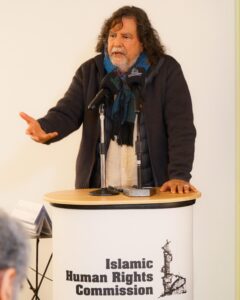
What is more relevant to our theme is that these attacks created a pretext for those in the security services, and it seems there were quite a few among them, including powerful people in the system, who used the attacks to demand from the politicians and the judicial system more power to curb the freedoms and rights of those they in a very sloppy and convenient manner associated with the perpetrat
ors of the terrorist attacks: namely anyone who is a Muslim, African or an Arab. This would have been akin to associate the terrorist attacks, and they were many, by white supremacists in the west, with anyone who is white. Of course, this would deem insane and unreasonable.
But it could be done in institutions that became outwardly more and more Islamophobic, Arabophobic, Africano-phobic. Under the title “the War on Terror”, the early signs of the relative attitude towards freedoms of expression and speech already appeared. But this was in many ways a prelude to a far more astonishing curbing of such freedoms evolving around the right of people to voice their conscious position on Zionism and Israel.
How do you frame support to victims of state terrorism that continues for more than a century, as support for terrorism? How do you frame rejection of a genocide as act of antisemitism?”
We then heard from Ramon Grosfoguel as he began by contextualising the present as a global civilisation imposed by European colonial expansion. It removed other civilisations “through violence, through destruction, through colonisation, through the enslavement of millions of people. We’re now 533 years on and we still haven’t caught up with the fact that we are in Western capitalist modernity. It’s a civilisation of death. It has killed millions of human beings, it’s destroying life on the planet.”
Grosfoguel then detailed the conquest of Al-Andalus and the expansion of the Christian monarchy. Ramon then began to explain how “what we’re seeing in Palestine is not new. This kind of settler colonial project is inherently associated with genocide because the interest of the coloniser is not to exploit labour of the colonised people. The interest is to take over their territories and occupy the land with their families. So, that’s completely different from exploitation colonialism where the coloniser is interested in enslaving the population.”
 His talk went on to correlate genocide and settler colonialism, with the context of history from Al-Andalus to Palestine today. Racism is an important element of divide and rule, a policy used by the civilisation of death that has expanded till today.
The conference concluded with Massoud Shadjareh, chair of IHRC, giving a vote of thanks. He talked about the pushback against the existence of Islamophobia at the start and how we have moved towards Islamophobes accepting Islamophobia exists but blaming the Muslims, the victims, for it. The demonisation and otherisations continues as the “Environment of Hate” becomes more dominant in society.
He highlighted that “we need to challenge this and this is not a job for Muslims to do, this is a job for the whole of humanity to do. Because this sort of demonisation, this sort of level of demonisation leads to genocide be it over in Gaza or what happened in Bosnia. Let us not think it won’t happen in Europe, we saw it happen in Europe. Once people are so demonised, then killing them and destroying them, it becomes the norm. And this is what ‘Environment of Hate’ is all about.
We need to stand for the dignity of man, united, all of us. Because it doesn’t matter who it is, what background, what ethnicity, what religion. The dignity of man needs to be guaranteed by all of us.”
Biographies: Speakers, Panellists and Chairpeople
Saeed Khan is Associate Professor of Near East & Asian Studies and Global Studies, and Director of the Center for the Study of Citizenship at Wayne State University in Detroit, Michigan. His recent publications include his anthology, Global Studies: A Reader on Issues and Institutions, and the co-authored book, What’s Going on Here? US Experiences of Islamophobia Between Obama and Trump.
Raza Kazim is a dedicated advocate for justice, an experienced educator, and a presenter.
With over 24 years as a spokesperson for the Islamic Human Rights Commission(IHRC), he has played a key role in organising major events, including Genocide Memorial Day and international demonstrations such as Al Quds Day.
Beyond activism, Raza has a string background in education, having taught in schools for 14 years and lectured at universities for 17 years. He has also contributed to the academic development of his local community by serving as a school governor.
Raza’s expertise extends into the media sector, where he has worked a presenter on Press TV, Islam Channel, and PTV, engaging in discussions on global justice, human rights and socio-political issues. His work reflects a lifelong commitment to education, advocacy and community empowerment.
CLIVE STAFFORD SMITH JD OBE is a dual UK-US national, the founder and director of the Justice League a non-profit training centre focused on fostering the next generation of human rights advocates. He previously founded and directed the legal action charity Reprieve (1999 in London). Since 1984 he has helped to represent over 400 people facing execution in the US and elsewhere. He also brought the first challenge to Guantánamo Bay, where he has secured the release of 87 detainees, and continues to assist the remaining 15. In all five of the cases he has helped bring to the U.S. Supreme Court the petitioner has prevailed.
In 2023 he took on the case of Aafia Siddiqui, the woman who has most suffered from the US rendition-to-torture program – abducted with her three children. He recently served a 349 petition in New York setting out the truth of what happened to her.
Clive has published a number of books including Bad Men (2008, describing work in Guantánamo) and Injustice (2012, on the capital case of KrisMaharaj), both of which were short-listed for the Orwell Prize; and most recently The Far Side of the Moon (2023), deconstructing the parallel lives of his father and a client Larry Lonchar, both of whom were labelled Bipolar. His next book, as yet incomplete, is An Extraordinary Life, which will be about your life and how to ensure you do something you truly love that contributes to the well-being of society.
While continuing his litigation practice, Clive is Professor of Law at Gresham College, he teaches part time at Bristol Law School and runs a summer programme for students in Dorset, his home. He has received all kinds of awards in recognition of his work, including an OBE by Queen Elizabeth II for “services to humanity” in 2000, and the Gandhi Peace Award in 2005, and nine honorary doctorates from a range of universities. He has been a member of the United States Supreme Court and Louisiana State Bars for over 40 years. He lives in Dorset, UK, with his family.
Richard Haley became a member of Scotland Against Criminalising Communities (SACC) shortly after it was set up in 2003 to campaign against human rights abuses committed in the name of the “war on terror.” He has been actively involved in the organisation ever since. He has participated in various initiatives against racism and Islamophobia in Scotland and is the author of SACC’s submission to the Inquiry into Islamophobia in Scotland conducted by the Scottish Parliament’s Cross Party Group on Tackling Islamophobia.
Zareen Taj Islam is a Trustee of Muslim Women’s Association of Edinburgh. When she served as chair of Radio Ramadan Edinburgh and producer of their news programme “Talking Heads”, she published “Poems from Prison” by Talha Ahsan.
Zareen currently works within the Cambridge community on issues ranging from climate catastrophe to anti-fascism and has been Secretary of Cambridge Stop the War since 2015 but maintains her connections with the Edinburgh community too.
As chair of IHRC, Massoud Shadjareh has overseen and been involved in EU-funded hate crimes research projects as well as providing expert evidence on issues relating to counter terrorism and extremism (Preventing Violent Extremism, House of Commons, Communities and Local Government Committee (Sixth Report of Session 2009-10)).
He has sat on the Home Office Stop and Search Review community panel, which addressed the disproportionality of stops against minorities under s.44 of the Terrorism Act 2000. He sat on the National Accountability Board, set up by the government to review the power to stop and detain individuals at any port in the country under Schedule 7 of the Terrorism Act 2000.
As co-ordinator of the Universal Justice Network (UJN) established in October 2008, Mr Shadjareh has convened and chaired various international conferences relating to conflict resolution and projects centred on modern Islamic civilisation. This includes the historic agreement in 2013 between Muslim Scholars of Pakistan condemning sectarianism, which has been a cause of conflict in the violent-stricken country.
Mr Shadjareh is a board member of the Decolonial International Network (DIN).
He has authored several papers and reports on Islamophobia and human rights, including, The Oldham Riots, Muslim Profiling, Islamophobia: The New Crusade and Whose Rights Are They Anyway?, published by the British Council.
Kaneez Hisbani is a Researcher and Publications Assistant at the Islamic Human Rights Commission. She holds a master’s degree in International Politics and Human Rights, with a focus on decoloniality and the rights of forced migrants affected by conflict.
Kaneez is a Presenter and Editor of Liberated Voices, a political podcast, and has previously served as the Political Advisor for ASA. With extensive experience in content production, photography (kfh.photos) and videography, Kaneez specialises in digital storytelling and social media strategy. She is a key member of the IHRC social media team, leveraging her experience to enhance online engagement.
Passionate about youth empowerment and community building, Kaneez has dedicated significant time volunteering with youth and student-based organisations. She advises on social media strategies for Muslim activism, helping individuals and organisations expand their reach and impact. Her work extends to fostering connections within her community, facilitating collaborations between various organisations and individuals.
Professor David Miller is one of the world’s leading academic experts on Islamophobia, and also specialises in the analysis of state and corporate lobbying.
Until his recent sacking by the University of Bristol, which resulted from an outrageous censorship campaign led by the UK’s Israel lobby, he taught political sociology. He also set up the UK’s lobbying watchdog, Spinwatch, which has tracked corporate power for 15 years. Spinwatch’s work has included investigations on the pharmaceutical lobby, the fossil fuel and fracking lobbies, as well as state lobbies that promote Islamophobia, such as those of Israel and the United Arab Emirates.
Ramon Grosfoguel is a professor of Chicano / Latino studies. He is internationally recognized for his work on decolonization of knowledge and power as well as for his work in international migration and political-economy of the world-system. He has been a research associate of the Maison des Science de l’Homme in Paris for many years.
Fahad Ansari is a human rights solicitor whose work over more than two decades has focused on counter-terrorism laws and policies, state violence, and the legal architecture of structural Islamophobia in Britain and internationally. He has acted in many of the most significant national security, deprivation of citizenship, and proscription-related cases of the past decade, often representing clients facing the sharpest edge of state power.