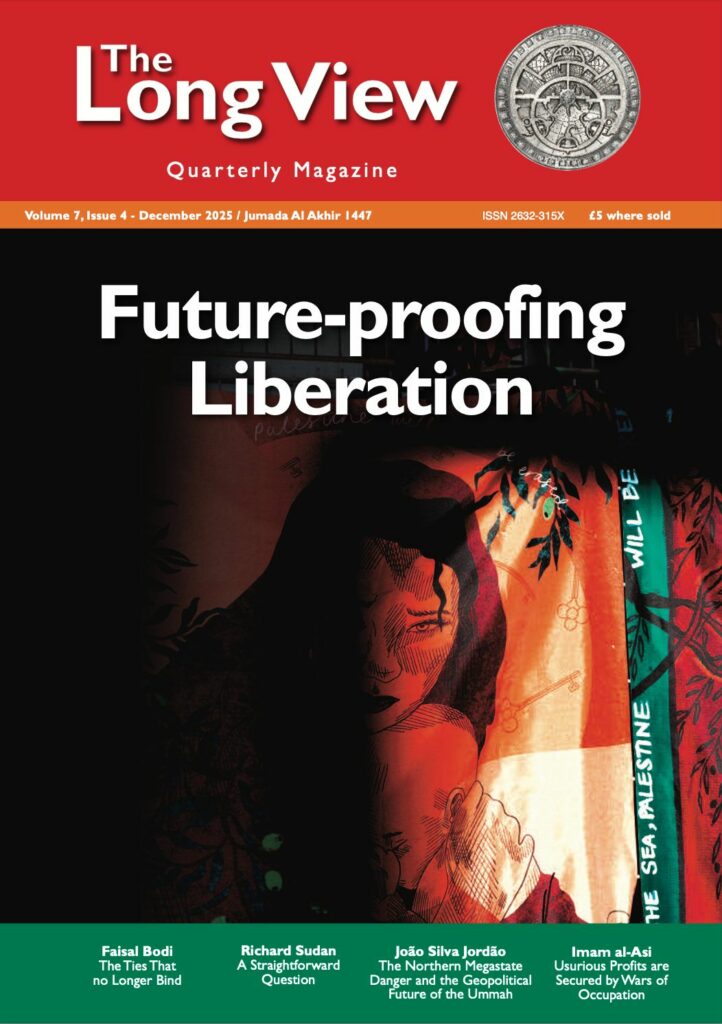
Future-proofing Liberation
Volume 7 – Issue 4 – December 2025 / Jumada Al Akhir 1447
Essays
Editorial
The two-year mark of the Gaza genocide has passed, and the unfolding evidence of the most heinous war crimes perpetrated by Israeli forces, including after the nominal ceasefire, has made certain that the world now sees the Zionist entity for what it is. This includes the majority of the populations of the so-called West, with even the US seeing seismic shifts in this period from its taken for granted pro-Israeli public, to even dissension amongst MAGA ranks. For all its current bleakness, it is yet, a new world.
What next then? This question, as impossible as it must have once sounded, is nevertheless urgent, and also, in the wake of these epic crimes, more possible to ask and answer. This issue of The Long View seeks to interrogate just that. We cannot wait for a just and liberated future to arrive unhindered and unplanned for. What should form its bases? How does this impact activists? On the geo-political level what can be done and what should parties be wary of? Can we ever, in all of this justify working with those who have been cheerleading the genocide? How do we prevent betrayal at the highest levels from current allies whose own allegiances may not as ideologically aligned as we had hoped?
Our first essay from Faisal Bodi looks at UK civil society and the tensions underpinning the anti-racist movement that coalesced around rights for first and second generation immigrants in the 1960s and which continues to advocate for equality for subsequent generations. The somewhat incongruous and hitherto almost unchallenged role of Zionist actors in this field is the focus of Bodi’s attention. Muslim and pro-Palestinian civil society groups have, by and large, acquiesced to the existence of such actors within the movement without serious objection, justifying it on the bases of expediency (“we must focus on the UK scene”) and or representation (“almost all British Jews are Zionist”). Bodi argues that these scenarios (which are also interrogated) can no longer justify (if they ever did), supremacist voices and organisations within anti-racist movements. This is no longer about abstract arguments regarding narratives of supremacism, but open support for genocide. If Muslims and pro-Palestinian activists in the UK are worth their salt they must begin to push back against dishonest voices in local liberation movements, which can no longer (and arguably never were able to be) divorced from liberation movements worldwide.
Richard Sudan’s piece on reparations is our second essay. Looking at existing calls from CARICOM’s commission, he argues that reparations cannot be excluded from future negotiations between erstwhile empires and post-colonial nations. The particularities of native genocide, trans-Atlantic enslavement and the ongoing traumas and inequalities generations after so-called emancipation and or sovereignty, demand restitution on multiple levels. It is a reset on the road to global recovery – economically, politically, but above all, morally.
The current moment has seen the rise of alliances between Russia and many non-aligned countries. Increasingly its activities in West Asia have seen it ally with axis of resistance countries. In Africa it has helped shore up revolutionary movements. But how much can Russia be relied upon as a long term partner? João Silva Jordão looks at the internal tensions created by the major civilisation narratives being heard in the Russian political sphere. Rather than envisaging a new world wherein it plays a role alongside rising civilisations and nations, there remains a strong westward looking trend. This trend places Russia at the nexus of a Northern Megastate – one that may eventually encompass the Northern hemisphere. Whilst these visions can be argued to be outliers, it Is nevertheless a fact that Russian political thinking contains heavy strains of westoxification still. Silva Jordão argues that Muslims in particular but social justice movements generally need to beware of this current in their current and future plans and negotiations. Not all is well in Russia. This essay is taken from the forthcoming book from IHRC, Is the Sun Setting on the Western Empire? Exploring Shifts in Global Power and Islamophobic Thinking, published in early 2026. The book contains presentations and essays from the conference of the same name held in 2022, with additional thoughts and essays from organisers. Since being presented the shudders of the old order collapsing, and the carnage it has created, have brought those discussions into sharp relief.
Our last essay is another of our periodical extracts from Imam Muhammad al-Asi’s tafseer of the Holy Qur’an. The extract focuses on verses from the third chapter that discuss the context surrounding and details of the Battle of Uhud in 3 AH (625 CE). Al-Asi argues that the verses make clear that the inequities and iniquities of the established order were based around riba (interest) and thus a battle for justice had to and did ensue between its defenders and upholders and the nascent Muslim community. In this he sees that parallels in today’s world, focusing on the Iraq war and the corruption that caused the travesty of the 2003 US-led invasion. The lessons for Muslims, and how to overcome them, are both, he argues, in plain sight.
And plain sight is indeed what we have today. No-one can seriously claim that the broken systems of governance, the inordinate injustices – from genocide at military hands to evisceration by cultural and political control – are anything other than the result of increasing power in fewer hands. If we are to achieve liberation for all oppressed peoples, then we must genuinely seek it. If we are to seek it, we must be honest in our search for answers. Join the search.