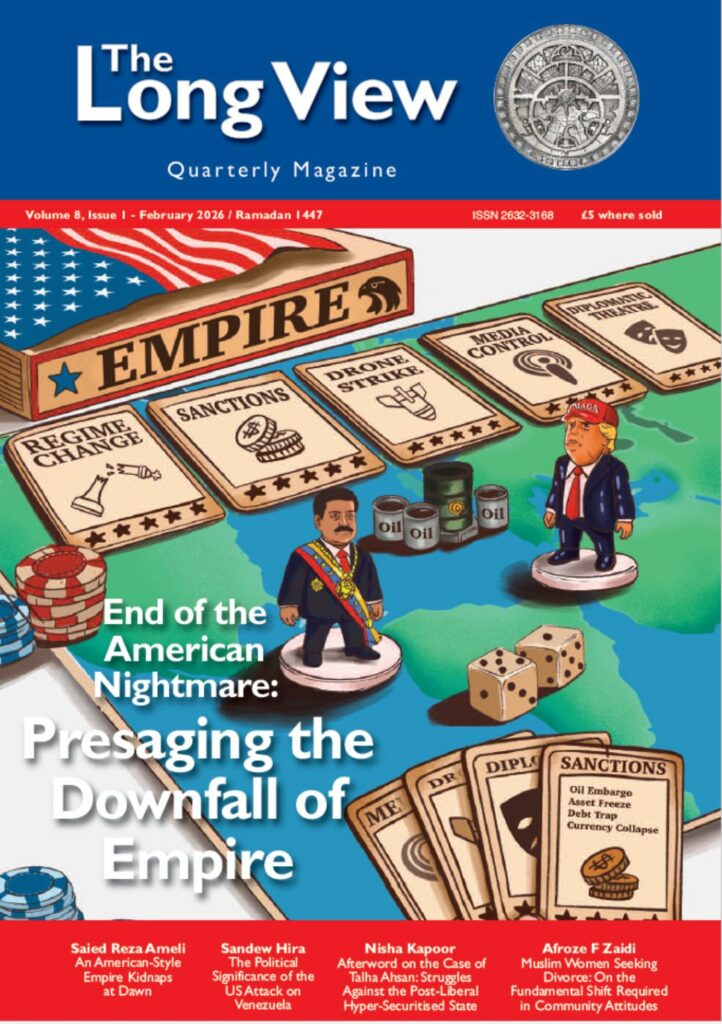
End of the American Nightmare: Presaging the Downfall of Empire
Volume 8 – Issue 1 – February 2026 / Ramadan 1447
Essays
Editorial
High on the hubris of abducting a popularly elected leader in South America, the US is beating the drums of war in west Asia. An armada comprising one third of the country’s naval assets (and rising) is stationed off the Iranian coast, waiting on its incorrigible commander in chief for the order to strike. Fresh from waging a genocide, an equally intoxicated Israeli military waits in the wings, willing its arrival and the anticipated removal of the last remaining obstacle to total colonial dominance of the region.
The extra-legal rendition of Venezuela’s President Maduro and the renewed preparations for war against Iran are the latest instalment of state violence by a belligerent power that has arrogantly placed itself above the requirements of international law. Under Trump even the pretence of innocence is no longer necessary anymore. Where once US administrations utilised fig leaves to conceal their violations, this president sees law as a mere inconvenience, an impediment to the projection of US power.
Our first essay in this issue by Saied Reza Ameli analyses the increasingly lawless nature of US foreign policy through the lens of the kidnapping of President Maduro. Demolishing all US claims to legitimacy for the action, he calls it an act of international piracy that trampled the most basic principles of sovereignty and self-determination. Maduro’s forcible rendition is a “logical extension of a governing philosophy that prizes unilateral force and political theatre over diplomacy and multilateral restraint”. It fits neatly into a long history of post-War US exceptionalism beginning with direct invasions and coups e.g. in Iran in 1953 and the overthrow of Guatemalan governments in 1954, to covert operations in Chile (1973) and the protracted sanctions and military pressures against Iraq in the 1990s and 2000s.
The message this sends to the rest of the world is chilling. International law applies only insofar that it does not conflict with US political or economic interests. Sovereignty and independence are conditional on US approval. As we have seen with Trump’s threats to seize Greenland, for smaller states the stakes are existential. The rest of the world must resist, for allowing another egregious violation by a rogue state only erodes further the fragile rules-based order on which peace precariously stands.
Our second essay by Sandew Hira takes optimism from Maduro’s overthrow and sees opportunity in the fact that US arrogance has made it drop the veil of adherence to international law, exposing its true nature. Where once more subtle, softer forms of influence might have sufficed, today a declining US if forced to rely on naked power.
Hira believes that the resort to ever more extreme and confrontational approaches might ultimately break US hegemony in different parts of the world. The US-led western empire is weakening at the periphery but also decaying from within. Rising levels of social, economic and political discontent at home – manifested in the rise of fascist figures and far right narratives – attest to the fragility of western “democratic” systems. “There is a growing anger in these societies,” he writes. “The challenge for the progressive movement is to capture it and divert it towards something positive: build a better world.”
If states like the US are becoming increasingly lawless on the international stage, it is only possible by a process of societal preparation at home that has conditioned populations to accept authoritarianism and repression. Governments have normalised carcerality, justifying it as necessary for public safety in the wholly confected “War on Terror” or the fight against “militant Islam”. Our third essay by Nisha Kapoor looks back at the case of Talha Ahsan as a forewarning of the kind of draconian surveillance state that has burgeoned under the ‘War on Terror’ casting its net much wider than the Muslim communities ensnared in its initial deployment.
Talha, who is now a distinguished poet, was arrested in the UK in 2006 under a US indictment although he had not committed any crime under British law. He was extradited six years later to face prosecution for terrorism offences and eventually released in 2014 following a plea bargain.
According to Kapoor Talha’s case shines a light on “the full obscenity of colonial and imperialist violence in Palestine and West Asia which… has required ever more coercive tactics to manage anger, despair and the ever expanding Palestine solidarity movement at home.”
The final instalment in this edition is a critique of the cultural attitudes surrounding female right to divorce in Islam. Looking back at her own divorce, Afroze Zaidi laments the patriarchal attitudes she sees inhibiting the spiritual autonomy of women seeking to dissolve their marriages. Even when it is not appropriate interventions for women seeking divorce centre invariably on marriage preservation, implying that women are treating the institution too lightly. This misplaced focus has left women feeling internally conflicted, questioning their own reality and spiritual self-worth and staying in unviable unions. “Accepting that divorce, too, is from Allah, and that there is no shame in the fact that Allah has ordained divorce for some, just as He has ordained marriage, would go a long way towards ending the stigma of divorce and the systemic gaslighting of women in difficult marriages who reach out for help and support”, she concludes.
This issue has tried to contextualise rapidly changing world events within a longer frame. To understand and analyse is the key to making sustainable and just change. This forward motion, even in times of deep crisis, is the key to building the future we need. With your thoughts and analysis join the movement for change.