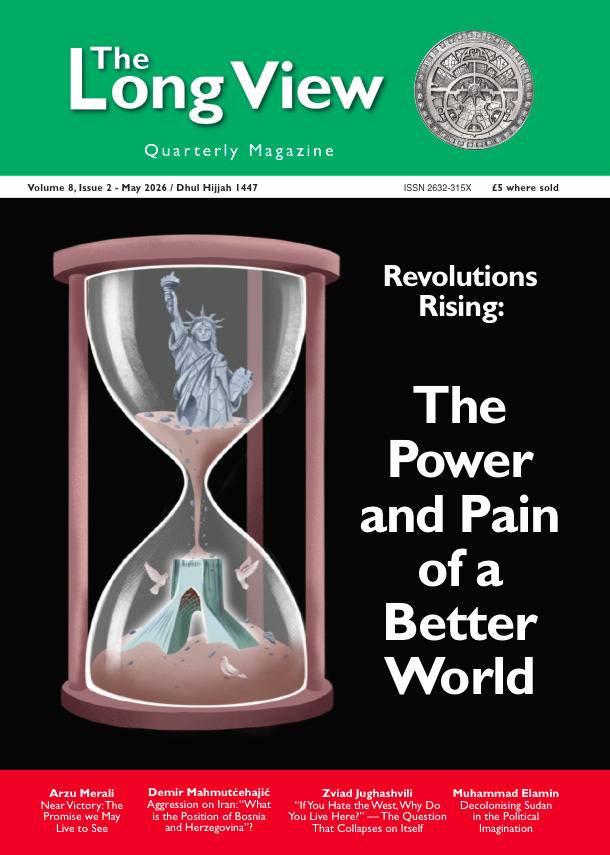
Revolutions Rising: The Power and Pain of a Better World
Volume 8 – Issue 2 – May 2026 / Dhul Hijjah 1447
Essays
Editorial
The opening salvos in the US/Israeli war against Iran took out the country’s Supreme Leader in an attack on his family home and obliterated 175 children in an elementary school in Minab.
The savage assassination of Ayatollah Khamenei, alongside other high-ranking politicians, was meant to advance the goal of decapitating the leadership. The double-tap attack on the school was an unadulterated act of terror, intended to demonstrate power and instil fear.
Neither attacks served their purpose. In the manner of his death the Sayyid won the martyrdom he yearned while the slaughter of innocent children only succeeded in rallying the population behind the Islamic Republic. Instead of destroying the government or cowing it into submission it fortified and emboldened Iran into a devastating retaliation that has ultimately brought the aggressors to the negotiating table.
In the first essay in this issue, Arzu Merali looks at the implications of this historic war on the accelerating demise of US Empire, and within that, the end of the Zionist entity. The whole world has been galvanised by the example of a besieged, sanctioned and blitzkrieged nation not only standing up to but strategically defeating the mightiest military force the world has ever known. If the genocide in Gaza opened the people’s eyes to the reality of the international political order, Iran’s stand has inspired them to resist it.
But Iran is much more than just a model of resistance and resilience. Its hybrid theocratic-democratic polity is also a living ideological challenge to the prevailing model of the western nation-state. That’s why, for the US and its ideological allies, it must be eliminated. An independent Islamic state is potentially disruptive to the post- World War 2 dominance enjoyed by the victors (and architects). Merali agrees with the late Imam Achmad Cassiem that what differentiates the 1979 Iranian Revolution from other uprisings is that its instigators had a plan and a vision.
Until the Islamic revolution, either collapse or capitulation has been the defining template for what happens when political Islam meets the modern state. “Demonised, overlooked, hidden alongside the understanding of colonialism is the model for decolonisation that is the Islamic Republic of Iran. Its institution building, its models of governance, they all require analysis, and understanding”, says Merali.
Our second essay looks at the views of the US/Israeli aggression of people from another country that has experienced occupation and genocide in recent history. Writing from his native Bosnia & Hercegovina, Demir Mahmutćehajić, says that opinion is largely divided, based on the demographic composition of the country. Nationalist Croats and Serbs who together make up approximately half of the population, have negative perceptions of Iran rooted in Tehran’s military assistance for Bosnia during the 1992-1995 war of independence. At the same time, their political representatives enjoy strong relations with the Zionist state which has made no secret of its desire to prevent the emergence of an Islamic state or even a strong independent Muslim polity in Europe.
Despite Iran’s historical assistance, views within the Muslim population are surprisingly not always sympathethic, something that the author puts down to the success of Saudi/Salafist anti-Iran and anti-Shia propaganda. These “Zionist agents”, as he calls them, popularised takfir of Shias and popularised the notion that Iran was engaged in a proselytising mission against the majority Sunni Bosniaks. This vilification was reinforced during the Syrian civil war in which Iran was presented as a sectarian genocidal anti-Sunni actor. Also, the retreat of Iran from its early revolution exporting foreign policy posture has meant that fewer Bosniaks, especially post 1979 generations, have been able to see or learn about Iran’s role in the country or its resistance to western empire. “The unique and most important lesson that Iran can teach the world is the Islamic Revolution!”, says Mahmutćehajić.
Muslims who admire the Iranian political system, or any other alternative to the western plutocratic nation state model, are often accused of being unfaithful to themselves and indeed even of treachery. Why do we continue to live in westernised settings if we dislike their polities so much? Our third essay by Zviad Jughashvili grapples with this conundrum. Jughashvili sees such interrogations as a rhetorical device camouflaged as an intellectual position, that “collapses complex questions—power, citizenship, survival, conscience, and community—into a single insinuation: that residence equals endorsement, and that critique equals hypocrisy.”
Jughashvili says the question is an evasive manoeuvre. “Residence does not erase conscience” and “criticism is not proof of hatred”. People can legitimately remain within systems that discriminate against or oppress them while actively resisting injustice.
The question is an ad hominem response, meant to shut down genuine discussion. If anything, it exposes the hypocrisy of a system that claims tolerance of different beliefs and opinions as a civilisational pillar. The “relevant question is what happens when one confronts taboo interests—especially in the areas of foreign policy, policing, and national security. It is precisely in these domains that the limits of the supposed openness of western political systems often become most visible,” he says.
The fallout of the attack on Iran has still more implications, not least so for the dominance of the US in Western Asia. As the chief US/Israel ally and staging post for military attacks against Iran in the region the UAE has borne the brunt of Tehran’s retaliation. Its carefully curated image as a tourist hotspot and financial centre have been damaged, perhaps irreversibly, by the ruling monarchies’ attachment to US imperial aims. Abu Dhabi’s poisonous tentacles are visible in Yemen, Syria, Libya, Somalia and Sudan among others. In the latter, it is accused of undermining the national government by providing military backing to the rebel Rapid Support Force.
Our final essay by Muhammad Elamin is the first in a series of instalments by the author explaining the war in Sudan. In this piece, Elamin explores the historical context of the crisis (this predates UAE involvement) he locates in the colonial reshaping of historic Sudan, more specifically the imposition of artificial borders, institutions and a sense of ‘nation’ as approximating to one ethnos, language and culture on the inhabitants. The author warns against employing Orientalised frames that simplify complicated conflicts into an Arabs vs African tribe dichotomy.
In times of extreme crisis such as we are living in now, it is easy to forget our dreams of the future, under the stress of today’s violence. Nevertheless dream and plan we must, if we are to reimagine the world free from its current systemic injustices. We hope these words are a small contribution to that. Let us know.