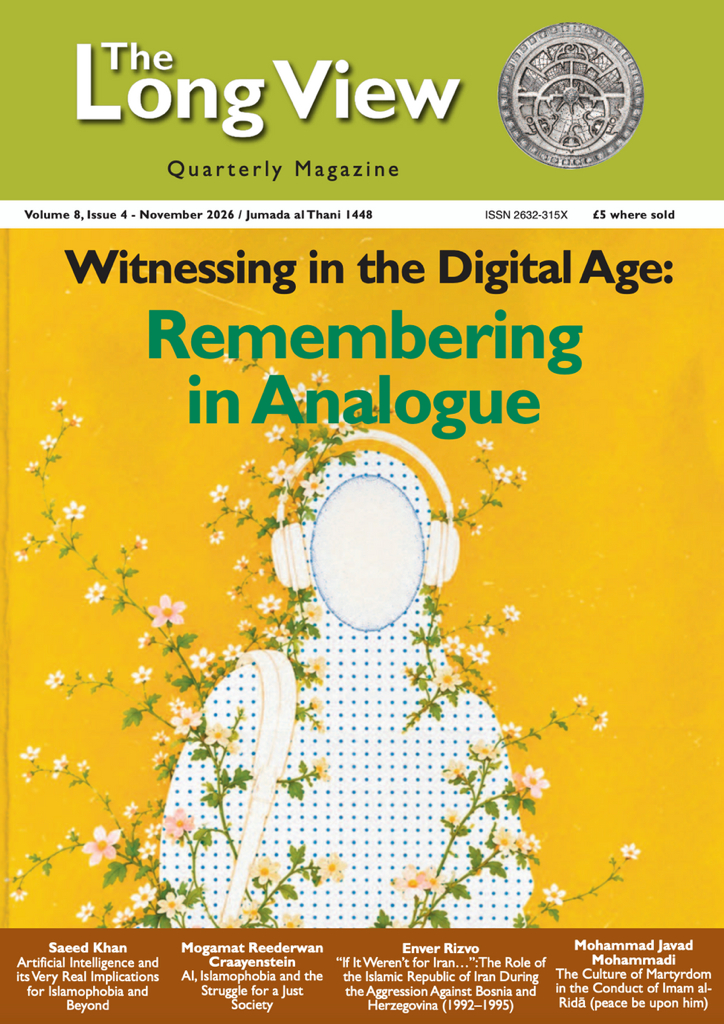
Witnessing in the Digital Age: Remembering in Analogue
Volume 8 – Issue 4 – November 2026 / Jumada al Thani 1448
Essays
Editorial
The rapid rise of AI throws up many questions and challenges. Its invisible integration into our already heavily automated lives advances apace leaving in its wake the regulatory frameworks and ethical constraints that should govern its course. Devoid of safeguards the field resembles a Wild West frontier where actors are driven by the basest human instincts such as greed, power and lust. Financial elites harness its vast capabilities to enrich themselves further at the expense of the poor and economically marginalised. Governments exploit its military potential to execute and enable a genocide and countless other egregious acts against their adversaries. Amoral business tycoons apply it for the purposes of monetising and debasing the natural human need for coupling.
Then there are the concerns about the dangers posed by so-called independent or autonomous AI systems, that is AI that has developed the ability to think for itself and act outside the limits set by its creators. The recent attack against Hugging Face is a case in point. Artists and authors have expressed alarm at AI companies seemingly bypassing copyright rules by buying physical books to scan for their knowledge reproduction models. When the acquired books are rare copies or manuscripts that are unnecessarily put out of circulation, it gives rise to anxieties about the monopolisation (and perhaps distortion) of information and knowledge. Equally worrying is the prospect that instead of being a net positive and egalitarian force AI will head down the same monopolistic proprietary route as the internet and be dominated by a few malevolent powerful individuals and corporations.
The first two essays in this issue of the Long View take a deep dive into the world of AI drawing out its potentialities as well as dangers. In the first which also forms the keynote speech for this year’s IHRC Islamophobia Conference, Prof Saeed Khan maintains that Muslims must not allow AI to bypass them and end up becoming merely its consumers and victims. The awesome power of AI will transform the world in ways that we may not yet even be able to fully comprehend but we are already trailing in the race to develop and procure it. Just as progress in science in the West starting in the 15th century provided the physical engine and ideological motivation for colonialism and the industrial revolution, AI stands to play a transformative role in global political power dynamics and an accelerative automating role in the global economy.
Muslims must be at the forefront of that effort argues Prof. Khan: “The absence of the Muslim voice from AI will deprive the world of a legacy and tradition of science and humanity being in concert with, not in opposition, to one another. But equally, if not more critically important, is the need for Muslim involvement in AI to minimise its potential to target Muslims by amplifying, coding and further institutionalising Islamophobia.”
The second essay by Mogamat Reederwan Craayenstein takes up the same theme. AI has not emerged from a vacuum. It is loaded with the body of assumptions, prejudices and practices that permeate the milieu in which it operates. This includes Islamophobia, more specifically institutionalised Islamophobia. Adjusting the algorithm isn’t the answer because this doesn’t address the human activity that goes into developing the AI model. Inputs are not value neutral. If a society is institutionally Islamophobic, automating its records and procedures is not going to generate anything but an Islamophobic output. Thus, AI has the terrifying power to supercharge discrimination. AI also has the disturbing propensity to undermine accountability distancing what are effectively human decisions from their authors, making socially produced judgements appear independent of the human beings who created them (the “sorry, computer error” scenario). The longing for a just society and the will to build a just society must precede the development of better algorithms for without them a post AI society will only end up reproducing injustice on a much bigger scale.
That justice does not stop at the boundaries of the nation state but extends to the responsibility of Muslim states to come to the aid of oppressed peoples everywhere. Our third essay by Enver Rizvo looks at the critical role played by the Islamic Republic of Iran in ensuring the survival of Bosnia-Hercegovina as an independent entity following its secession from the rump Yugoslavia. Under the late Supreme Leader Ayatollah Seyed Ali Khamenei, Iran approached its relationship with the nascent Bosnia from the standpoint of a constitutional and religious obligation. Against a punitive UN arms embargo which failed to distinguish between aggressor and victim and between the armed and unarmed, Tehran made it its business to supply hardware as well as personnel, technical knowhow and intelligence helping to turn the tide of an initially one-sided conflict.
Our final essay stays with Iran. Written by Dr. Mohammad Javad Mohammadi it elucidates the culture of martyrdom that has sustained the Islamic Republic and its leaders since inception. It is this culture, which grows out of faith, that was both inculcated by the late Seyed Ali Khamenei and in which he was immersed until his final breath. Using the life of the 8th Shia (Twelver) Imam, Ali ibn Musa al-Rida (AS), Mohammadi identifies the key components or pillars of this culture which he says must be imbibed and actualised by the martyr before his martyrdom: faith, sincerity, knowledge, striving, and steadfastness. The martyr is one who strives; they spend a lifetime labouring in the service of the Truth. Witnessing truth, in service of the Truth, is an aim shared across boundaries. Let’s join together in this struggle to bring truth and justice to light.