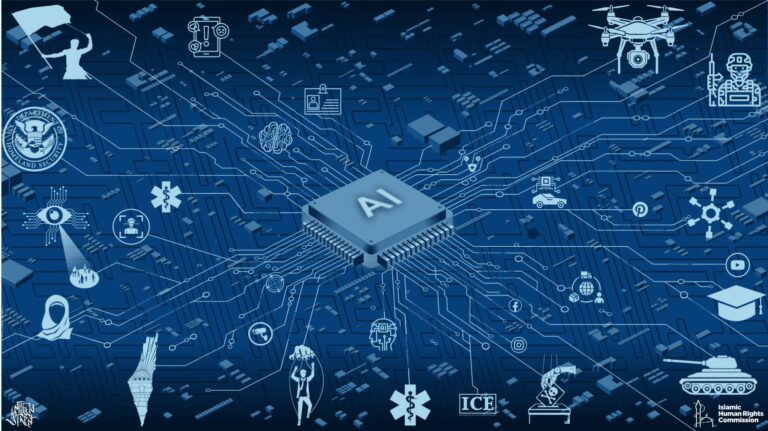

Setting out the concept for this year’s IHRC, SAC & DIN Islamophobia Conference in the UK, Saeed Khan sets out the challenges, the possibilities and very real dangers faced by humanity caused by the development artificial intelligence. Is this new technological age able to develop in an ethical manner, or are the horrors we have already witnessed portents of what is to come?
Author’s Disclaimer: No artificial intelligence was used to write this article.
Artificial intelligence (AI), once the exclusive domain of science fiction, is approaching science fact and reality. And while some contend that AI is already here, AI with self-awareness approaches a scientific reality in the near future. Today, scientists and tech specialists at some of the world’s finest universities and private facilities work energetically to advance the fields of robotics and AI development. Yet, the necessary debates regarding the consequences of AI’s impact on humanity are woefully insufficient. This deficiency is particularly pronounced in faith communities, whose voice and discursive contribution borders on the non-existent., and more specifically the Muslim community, already and constantly under the siege of Islamophobia.
As technology advances at a pace that challenges the ability to discern its philosophical implications and consequences, it is critical for thought leaders to deliberate upon the myriad ramifications of artificial intelligence and its constitution. As efforts will be made to confer upon artificial intelligence greater agency, questions abound as to what its parameters and limitations will contain. With equal importance and in response, one will have to explore how human agency can be curbed from its impulses to use such transformational technology, human beings may have to reevaluate and redefine their own notions of personhood as they interact with AI and its incarnations. The last century bears testament to the misuse of technology by subjugating and exterminating humankind by those who created it and chose to use it as a force for harm instead of societal benefit. AI now provides that potential yet again, with its military, media and anti-ethical applications. In fact, it has already begun.
The May 2021 the Israeli assault on Gaza is regarded as the world’s first artificial intelligence conducted war because of the Israeli Defense Force’s (IDF) heavy reliance on AI during its onslaught. The IDF used algorithms for data collection and target selection. In the eleven-day campaign, United Nations and local Gaza Health Ministry reports estimated over 250 men, 40 women and 66 children were killed, and approximately 2,000 were injured. This particular conflict simply served as a prologue and a recce for what the IDF would unleash after October 7, 2023.
The actual number of Gazans killed since October 2023 will never be known, as Israeli forces have blocked access to the region and have embarked on clearing debris which ostensibly contains the human remains of untold thousands, not to mention the mass graves the IDF also established. Conservative, verifiable numbers estimate the Israeli military killed over 75,000 Gazans, a tenth of what is perceived to be the real quantity of carnage. The IDF destroyed every school, university and hospital, as well as Gaza’s infrastructure, including water purification plants, electricity power plants and grids and other key installations.
For the past three years, Israeli forces have refined and incorporated more broadly the use of AI in Gaza. One such use is Lavender, a system that collects and mass surveillance data. Supposedly for the purpose of identifying militant groups, per Israel’s definition of that term. According to the International Institute for Strategic Studies (IISS), the Israelis used Lavender to generate large, automated kill/target lists. America’s National Public Radio (NPR) confirmed the IDF’s use of an AI system called “The Gospel,” stated similarly to use artificial intelligence to identify militants; the media outlet critiqued the efficacy of the AI, given the heavy civilian casualty count, leaving only two plausible conclusions to infer: either the IDF was less competent than previously thought despite multiple claims it took all possible measures to avoid civilian deaths, or they willfully and intentionally targeted civilians as well to maximise the extermination of Palestinians, thereby refuting the dubious claim that the IDF is the “world’s most moral army.”
Contrary to an extensive propaganda campaign denying its intentions and executions, the Israeli military and government is using an AI platform known as Habsor (“the Gospel”) , which is specifically utilized to assess physical targets. Ostensibly claimed to be used only to find militant targets, like tunnels and weapons caches, Habsor has been used to locate, target and destroy crucial infrastructure that only has humanitarian use. This includes electricity grids and power supplies, water purification centers, internet and telecommunications facilities, schools, universities and hospitals.
Several sources have designated Gaza to be the most surveilled region in the world, and such use of AI technology facilitates the ability of Israelis to map the entire area, including any and all civilian sites. Again, the Israelis insist they do not target civilians, including women and children, a claim made even more specious given the sophistication and precision of AI to distinguish between combatant and civilian positions. Either AI is inaccurate or it is programmed and used to maximize destruction and killings.
Starting with the 2021 Gaza war, Israeli military and intelligence services, including its elite Unit 8200 Intelligence Corps, have been developing AI applications to surveil, securitize, monitor and target Gazans. According to the Jerusalem Post, programs such as “Alchemist” have been engaged in collecting data using signal intelligence (SIGINT), visual intelligence (VISINT), human intelligence (HUMINT) and geographical intelligence (GEOINT). No square foot, person or even animal is protected from this perpetual panopticon. It is tantamount to the predator hunting its prey with the most advanced technology available, even if it means creating that technology for such a bespoke purpose.
Data collection and target selection are just two elements of AI’s military applicability. AI also allows for the enhancement of non-human weaponry, such as drones and AI-assisted missiles. Each of these weapons systems depends on algorithmic technology, as is utilized in other military capacities. One can assume that countries like the United States employ such technology for their missile telemetry systems. Despite the claims that such technology minimizes, not increases, precision and thus, arguably reducing civilian deaths as “collateral damage”, on February 28, 2026, the first day of the US-Israel War against Iran, American missiles struck an Iranian girls’ school in Minab, killing over 168 people, including more than 120 little girls. Similar high causalities have occurred by American AI facilitated munitions, including in Afghanistan, when several Afghan wedding parties have been hit, killing hundreds, in 2002, 2008 and 2019.
Drone warfare has marked a decided, irreversible shift from the era of military warfare when soldiers could see their adversary eye to eye. The impersonal and anonymous nature of war today allows for detachment of human emotion from the calculus. This departure is widened when AI is used for decision-making, and with it, a critical component of ethical involvement for the user of such technology. Leaving the crucial judgments in the hands of the algorithm assuages the human supervisor of culpability and perhaps even criminal liability should there be an error or even a foreseeable action. Moreover, international law, already addled by contempt and defiance by its very creators, appears woefully inadequate in addressing the prospect of war crimes, genocides and crimes against humanity being outsourced to non-human actors, where militaries and governments alike can claim that it was “machine error” to blame.
The awesome power and capability of artificial intelligence merges with a similar phenomenon in contemporary society to create a perfect storm for the potential of misuse, manipulation and distortion of the truth and reality. The media have become a conduit and creator for AI in a variety of fields and applications. Many newsrooms in print and broadcast media rely upon AI for generating content. Sports results, financial markets reportage and even weather and traffic reports have become deeply infused with AI technology and in some cases, operate with a consistency akin to autopilot feature on aircraft. Predictive AI, for example, employs meteorological forecasts and models to determine weather changes in advance of its development, greatly improving upon human analysis due to the speed by which such data is processed. In some ways, this technology has proven to be a lifesaver, especially when plotting the course and trajectory of natural disasters like tornados, cyclones and hurricanes. AI monitoring of traffic patterns can aid drivers, especially commuters and emergency vehicles, avoid long delays due to accidents, congestion and/or construction. And now that the global financial markets operate in a 24/7 macro-ecosystem, AI can collate information from stock exchanges and other institutions to provide real-time updates and even future projections and trends. But as efficient and effective as AI may be in these important arenas of social engagement, it is not a perfect science. AI models still miss storms, with damage and destruction still occurring, though human casualties are often mitigated with early warnings. So-called black swans- rare, unpredictable events that carry a massive impact- elude AI prediction models based on their statistically low levels of occurrence, though they can wreak havoc on the financial sector, as evidenced by the Covid-19 pandemic. While AI can be “forgiven” for its limitations, the concomitant concern is the extent to which human reliance makes critical decisions based on “faith” in the reliability of the technology, particularly when such technology is seemingly visible yet invisible at the same time.
Media use of AI models for weather, traffic and markets carries certain risks which may be argued to be similar to direct human agency in these areas. But the media is also responsible for establishing the lens through which we gain access to and process information. Hyper corporatization of major media outlets has subsumed journalistic integrity to the interests of shareholders, special interest groups and governments, even those in whose countries such outlets are not headquartered. In the pursuit of higher profits, most media outlets have drastically cut their international bureaus and network of on-the-ground correspondents, relying instead on bundlers and AI to fill in the gaps in their reporting. AI is thus a poor substitute for the painstaking work that journalists invest by embedding themselves in local communities, building trust and becoming privy to the nuances and intricacies that make a story more vibrant and accurate. AI, irrespective of how well populated the algorithm might be, can never capture those subtleties. It is thus telling and beyond irony to note that the person absorbing media accounts is called the consumer.
But beyond imprecision based on logistical deficiencies and gaps is the greater danger that AI brings to an already dubious discursive landscape created by the media: the editorial bias that AI can create and reinforce. Media reporting suffers from the twin related sins of bias and willful omission. There is a multitude of research and scholarship that focuses on this phenomenon, especially as it pertains to and foments Islamophobia. Coverage of Gaza since 2023 is just one small example of how western media outlets manipulate and shape public opinion. Studies show how prominent and highly influential sources like The New York Times routinely use passive voice and elide naming Israeli military and government personnel that murder Gazans while emphatically invoking active voice when Palestinians are the actors. Additionally, The New York Times, as is the case with the BBC, shows its scepticism as to the accuracy and probity of casualty counts reported by Palestinian agencies or individuals, claiming such numbers are inherently unreliable because they may be Hamas propaganda. By contrast, any estimates provided by Israeli voices are accepted as dictum, even when refuted by independent sources. As this matrix of misinformation becomes merged with AI, the danger increases exponentially of distortion and deception becoming further mainstreamed because of the logistical nature of the technology.
AI currently operates and thrives through the almighty algorithm. This is achieved by those who program it to filter the vast corpus of information available on the internet. Programmers can “tell” the algorithm what information is acceptable for it to process, replicate and then report with its imprimatur, allowing the bias of the programmer to become embedded in the system. In addition, the algorithm may then be utilizing its limited range of acceptable sources further with the pool of information from which it draws its “expertise,” ones that are already skewed, yet regarded as authoritative because of their origins from leading media outlets. The illusion (or delusion) of the media being a democratized space is deepened when an algorithm can discount and dismiss counternarratives furnished by alternate media outlets and independent sources, effectively erasing them from the public record. These dangers of this process are further exacerbated by the fact that AI appears to make its users passive participants. It is one thing to resist the urge to question every weather report or traffic update that AI provides; doing so in real time might become cumbersome, if not frustrating, both for that particular person and those who are inadvertently involved, including other drivers, for example. But engagement with the media is never healthy as a passive exercise; journalism should be questioned, critiqued and challenged for its biases, inherent and otherwise. The ease by which society “trusts” AI in so many time and labor-saving sectors will seep into the calculus of media consumption, making unhealthier an already toxic public space.
If AI is changing the complexion and coverage of traditional media, the relatively new frontier of social media is where the impact of artificial intelligence is being felt profoundly as well. Initially heralded as a welcome departure and rejoinder to so-called mainstream media at its inception nearly a generation ago, social media was intended to allow for the democratization of the public discursive space, where anyone with an opinion could have greater and easier access to the marketplace of ideas, rather than the increasingly filtered ecosystem dominated by broadcast and print media. Anyone with an email address, a website or simply an account to one of a growing number of platforms and apps could enter the arena in ways that overcame conventional and long-established barriers to access. Blogging pages allowed for people to become diarists, commentators and even citizen journalists. Just as critically, it opened up a way for people trapped in media voids to present their voice, not only to add to the discourse, but also to refute biased media accounts that claimed impunity and authority absent other coverage. This has been the reality in Gaza, for example since well before 2023, but gained greater currency and credibility after October 7th.
The Israeli narrative is fond of emphatically claiming to be a thriving (“only one in the Middle East”) democracy, with respect for the rule of law and freedom of press and speech. This, of course, is being severely challenged with calls for the Israeli producers of the new documentary, NAZA, to be stripped of their Israeli citizenship for chronicling the confessions and admissions of Israeli military personnel recounting the atrocities they were ordered to commit in Gaza. In addition, so committed to a free press is Israel that the state holds the dubious distinction, according to Al Jazeera, of killing more journalists in Gaza than the number of reporters killed in all major 20th and 21st century wars combined, including World War I, World War II, the Vietnam War, the 1990s Balkans Wars and the American war in Afghanistan. Those journalists the IDF did not kill, and overwhelming evidence suggests such killings were deliberate and intentional, not incidental as Israel contends, were barred from covering Gaza on the ground, due to severe censorship protocols. The IDF, with no sense of irony, claimed it could not guarantee the safety of journalists in an active warzone as its justification for restrictions. Of course, it prevented western journalists from entering Gaza, leaving the risk and eventual targeting for other media members, as demonstrated by the disproportionately high death toll among Al Jazeera correspondents. But Israel did allow in some western journalists when it suited its narrative, as evidenced by its demand that any reportage first be cleared by its own censors before it could be broadcast. The acquiescence and complicity of these media outlets was affirmed by their willingness to agree to such restrictions and procedures, while happily boasting about their moral superiority as purported bastions of free expression. Intrepid and courageous Gazans risked their lives and lives of family members to overcome unimaginable odds and obstacles, including the Israeli destruction of Gaza’s internet grid, to send the world images and information to bear witness to and prove, especially to the International Court of Justice, of a genocide underway, in real time.
Social media is often ascribed the metaphor of being the “Wild West” of the public sphere, by virtue of its accessibility of ideas and information ignored or blocked by traditional media outlets. But the efforts to bridle or rein in social media are coming from those interested in control instead of an earnest interest in distilling the space of distortion and deception. Some of the world’s most powerful social media platforms are hypocritically employing the very tools of censorship they claim to be defying. When Elon Musk purchased Twitter, he pledged to restore the site to its “pre-woke” openness. In reality, Musk gauged “wokeness,” conventionally described as political correctness that seeks to stanch discussion on topics that are deemed inappropriate. Instead, Musk allowed “anti-woke” postings that included sexually explicit content and racist, bigoted rhetoric. Musk also instructed his website administrators to police and block content, even suspending user accounts, of people posting pro-Palestinian messages and content showing the truth of what was occurring in Gaza, in full refutation of Israeli distortions. These administrators use AI to search for objectionable content to efficiently hit back decisively and swiftly. Musk also allows his website to be saturated by AI “bots,” preprogrammed responses to any targeted content, in this case, pro-Gaza posts, with an avalanche of anti-Gaza lies and bigoted replies.
Elon Musk is not alone in controlling critical social media platforms using AI and bots to counter information determined to be by them appropriate. Marc Zuckerberg’s Meta is the parent company to Facebook, Instagram and WhatsApp. In 2020, Zuckerberg appointed Emi Palmor, the former director-general of Israel’s Justice Ministry, to Meta’s Oversight Board, a body tasked with ruling on content ethics. Previously, Palmor had set up a cyber unit in charge of monitoring and censoring Palestinian social media posts, on the orders of the extreme right-wing minister Ayelet Shaked. Palmor is now the gatekeeper over three prolific and extensively used social media platforms to prevent users from posting questionable content; here, that translates to pro-Palestinian information. Meta is also a major player in the AI industry, seeking to develop the cutting-edge technology for the next generation of AI and its further integration over all aspects of social engagement. These “gatekeepers” of AI and social media have used the Gaza war and the public outrage it has generated to workshop ways to censor expression and conduct an assault on democratic principles, both with and without state cooperation and complicity.
AI does not only stand for “artificial intelligence.” With this technology and its pernicious and potential dangers, it could just as easily mean “accountability immunity.” There is the prospect that AI could be used to conduct activity that would otherwise be illegal, not to mention immoral were it done by humans. In essence, AI could be a mechanism to outsource criminality under the guise that a non-human entity committed it or, equally, problematic, that AI acted on its own accord because it had developed its own “consciousness” and autonomy. Of course, the human being(s) responsible for developing the original algorithm and parameters for the AI’s action would and should be held culpable, but there is certainly the probability that such actors would launch a defense that their involvement was too attenuated from the crime committed. Moreover, the die has already cast whereby non-humans escape the form of criminal liability that human beings do. Corporations are notorious in evading punishments that people experience. At most, they are subject to monetary penalties and perhaps some relatively nominal injunctions to prevent future, repeated action. Such consequences invariably pale in comparison to the toxic impact of what corporations have done and hardly serve as a sufficient deterrent to another occurrence. At a time when public discourse is focused on the misuse of AI by so-called “bad actors,” the negative effects will be exacerbated if no one feels afraid of being held accountable, a reality that already exists with the impunity by which genocides are conducted in full defiance of the rule of law.
Beyond the technical capabilities of AI and the dangers of its manipulation and misuse, there is the equally, if not greater concern about what artificial intelligence will do to the human condition itself. Some will claim that the Industrial Revolution ushered in a brand (brave?) new world of scientific progress and human advancement, thanks to the time and labor-saving benefits of the knowledge and devices it produced. Notwithstanding the fact that the Industrial Revolution was launched on the backs and with the blood of countless millions who were exploited, subjugated, occupied, maimed and murdered through the scourge of the colonial project, industrialization changed human nature. The science and development of the 18th and 19th centuries engendered a hubris amongst its creators who felt they had now been able to control and even conquer the natural world. It is little wonder that such a process compelled German philosopher Frederich Nietzsche to declare that “God is dead,” lamenting that secular reason and scientific advancement had stripped humanity of the morality and human purpose that other ethical constructs like religion furnished.
The Industrial Revolution augured a mass delusion for its purveyors, that somehow, they could conquer nature and be sophisticated and “civilized.” The West’s subjugation of most of the planet was sufficient refutation of that conceit. But the West did not spare itself of its own, newly refined brutality. The systematic efficiency of the new science and mechanical progress simply enabled the West to use such knowledge to exterminate peoples more effectively, as evidenced by two world wars. There is little indication that the West used its experiences during those conflicts to engage in any self-reflection, let alone contrition. As such, it is doubtful that effort will be made to ponder, even at this relatively preliminary stage, what and how AI may change humanity.
As transformative as the Industrial Revolution may have been to impact society and humanity, AI has the potential to provoke deeper questions about the human condition, including what and how does AI relate to concepts like the human soul (nafs) and one’s intrinsic state of being (fitra). Unlike the Industrial Revolution, AI may challenge human beings to reexamine, or perhaps for some examine anew, what does it mean to be human as a means of distinction from AI. The Enlightenment philosopher Rene Decartes declared, “Cogito, Ergo Sum,” i.e. “I think, therefore I am.” If AI develops “consciousness” and autonomous thinking, then it could conceivably claim to “be” because it, too, thinks. Until now, human beings could presume the definition of personhood as self-evident, perhaps being confined merely to distinguishing humans from other animal species. AI will require a deeper deliberation on what makes humans unique if the ability to produce knowledge is no longer a monopoly they enjoy.
Historically, the custodians of the definition of personhood have been theologians. They have been imbued with the ability and task to interpret the divine imperative for human beings, including the parameters and purpose intended for creation by the Creator. Now, perhaps more than ever, they need to affirm and assert what it means to be a conscious being with a conscience. It will require them to engage with the creators of the new technology, not all of whom are gorged with sinister intent. In fact, many are displaying a humility by acknowledging the dangers of AI running amok. Those that have decried the unpredictable results of AI models and scenarios have rightly sought to place curbs on AI research until certain safeguards can be implemented. They have also implored engagement with theologians, ethicists and philosophers who can discuss and define guardrails and regulations on AI’s capacity and capabilities. The questions that remain unanswered are whether such engagement will in fact occur and just as significantly, whether there is still time to learn from and apply the prescriptives from that interaction.
The ability for AI to emulate and in some cases surpass human intelligence is remarkable to say the least. Predictive AI allows for medical science to delve into areas previously unimaginable and with its depth of exploration, capable of saving lives and offering therapeutic treatment more quickly and successfully than ever before. It is quite possible that people will begin to rely on the efficacy of AI in its medical application to approach the level of faith. Such a prospect allows for a rather tantalizing possibility, beyond the obvious scenario of people transferring faith from the divine to that of the deus et machina. Faith in AI could have another, unintended casualty as well: atheism. If people who eschew belief in a divine presence start to place their faith in AI, the choice of non-belief disappears as a matter of course.
Irrespective of the myriad inquiries that remain as to the various consequences and impacts of AI on humanity, be they beneficial or otherwise, a few indisputable realities exist. The awesome power and potential of AI will transform the world in ways that may yet be outside our comprehension or level of comfort. But the future of AI, at its elemental level, will be decided by who has agency in not just its development, but also in its procurement. The Industrial Revolution offers a history of scientific and technological triumph, but it also chronicles some of the darkest eras of human history in the violence and brutality it yielded and also required as oxygen for its own nourishment. The destinies of hundreds of millions were determined and dictated by a precious few; AI has the prospects for a similarly disproportionate ratio between the impactors and the impacted. Current debates about the fears that AI might fall into the hands of “bad actors” is both poignant, yet somewhat hypocritical. The proverbial hand wringing is coming from some of those countries that may well be among those bad actors. There is also the presence of selective indignation; while the United States warns of the dangers of AI being misused by China, Iran and Russia, it conveniently exempts countries where AI is already being used, and in nefarious ways, such as India and Israel. The only consistency that can be discerned is the potentially and disproportionately dangerous impact on the Muslim community as Islamophobia can become deeply embedded into AI, especially if Muslims are excluded from how AI is crafted and deployed.
A thousand years ago, Muslims ushered in not only the so-called Golden Age of Islam with a plethora of knowledge generation; they also made an indelible mark and contribution for humanity. Such knowledge was in part a religious imperative and served to affirm divine inspiration, not, as occurred in the West several centuries later, a mission to marginalize or disprove the divine. Islamic knowledge was the culmination of the contributions of Muslims and non-Muslims alike, whether the absorption of the “zero” from Hindic civilization or the scholarship of Musa bin Maimon (Maimonides), the great Jewish Cordoban. New innovations were painstakingly considered for their societal impact, weighing costs and benefits as well as risks and harms. Inventions and discoveries were for the betterment of humankind, not intended for its destruction or domination over others. Muslims showed, time and again, that knowledge, science and innovation could and should be a force for good and a benefit to humanity, not a source of exploitation and destruction. That ethos must be at the cornerstone of how one must approach AI. The absence of the Muslim voice from the future of AI will deprive the world of a legacy and tradition of science and humanity being in concert with, not in opposition, to one another. But perhaps equally, if not more critically important is the need for Muslim involvement in AI to minimize its potential to target Muslims by amplifying, codifying and further institutionalizing Islamophobia.
AI is an unavoidable reality that certainly has a host of beneficial applications, some that are currently occurring, with many more to come. But it would be improper to assess a new technology even if it has a net positive benefit to humanity, if its negative impact is high, heavy and irreversible. AI has that latter potential even without nefarious actors trying to fulfill that outcome, but the prospect of greater harm through intentional action must be prevented at all cost. The vigilance and input of a fourth of humanity, especially a segment of humanity that contends with Islamophobic or Islamophobically motivated deployments of AI, is vital not only for its own future, but that of humanity as a whole. A millennium ago, Muslims introduced the world to the word, algorithm. It is incumbent upon the world to allow them to be fully involved in determining its scope, scale and service for the future.
Saeed Khan is Professor of Near East & Asian Studies & Global Studies and Director of Global Studies at Wayne State University, Detroit, USA. He will be co-chairing the 2026 IHRC and SACC Islamophobia Conference on ‘Artificial Intelligence and Islamophobia’ which will be held in person and online on 13 December 2026. Find out more on the IHRC website, and find the proceedings of the previous twelve conferences here. Khan is a regular contributor to The Long View. His most recent publications include “What’s Going on Here? US Experiences of Islamophobia between Obama and Trump“, co-authored with Saied R. Ameli for Islamic Human Rights Commission publications.

![[photo:Azerbaijan_flag]](https://www.ihrc.org.uk/wp-content/uploads/2011/03/Azerbaijan_flag.gif)