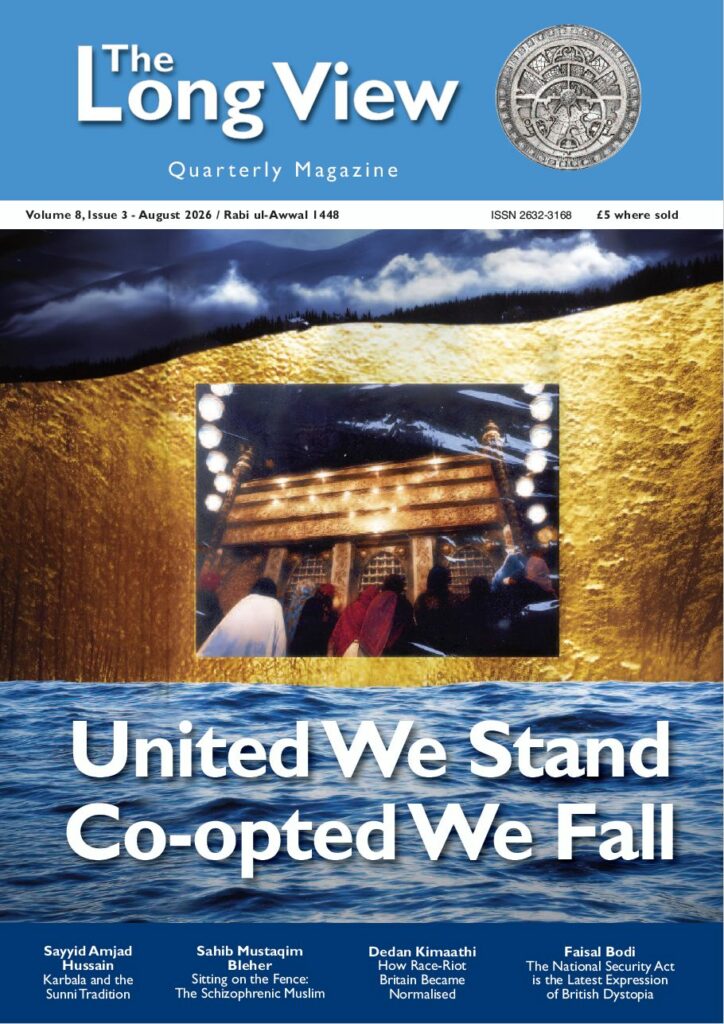
United We Stand Co-opted We Fall
Volume 8 – Issue 3 – August 2025 / Safar 1447
Essays
Editorial
The revival of sectarian narratives has been a salient if unedifying feature of the Ummah’s response to the genocide in Gaza. In time honoured fashion, as the House of Islam is assailed from all sides, many of its inhabitants are more preoccupied with attacking their co-religionists than joining hands to defend the building. Instead of finding motivation in the impulse to self-defence, compassion and ending suffering, they hasten to rake up and accentuate historical mutual rivalries as if this is the immediate Ummatic priority.
Sadly, the noise comes across as criticism of people resisting Israel’s ongoing slaughter on the basis of their assumed confessional status. Mischievous and/or misguided Sunni movers and shakers take aim at the huge sacrifices made by the Shi’a of Iran, Lebanon, Yemen and Iraq, belittling or negating them on account of doctrinal differences and historical grievances. They rekindle divisive polemics either to deflect from their own inexcusable betrayal of Palestine or because they are simply incapable of thinking outside the sectarian box.
The result is that where shared beliefs and priorities should lead towards convergence, they tend towards conflict. This in unfortunate and unnecessary, according to Sayyid Amjad Hussain, and is exemplified by the changing Sunni attitude towards the commemoration of the martyrdom of the blessed Prophet’s grandson, Hussein in the massacre of Karbala. In the first essay in this issue, Shah argues that the original Sunni reverence for Hussein has given way to a misplaced identitarian suspicion.
“The strange thing is not that some Muslims remember Karbala. It is that others have learned to forget it. For most of Islamic history, remembrance of al-Husayn رضي الله عنه was simply part of the Sunni landscape — and not a quiet one,” says Shah. In the Ottoman lands, in Mughal and pre-Mughal India, across North Africa and throughout the Sufi orders, the tenth of Muharram brought sermons, elegies, and gatherings of grief that no one mistook for Shi‘ism…. this was the texture of Sunni piety for centuries, and the Sufi orders treated Karbala as a standing lesson in sacrifice, justice, and the refusal of tyranny.”
The abandonment of Karbala as a moral, let alone political, paradigm is reflected in another modern malaise, the “schizophrenic Muslim” as Sahib Mustaqim Bleher puts it. He reflects on the reluctance of Muslims in the West who refuse to engage with Islam as a way of life, seeing it as a convenient bolt-on to certain aspects of their life. Where it is unintrusive it is welcome but where it involves discomfort and sacrifices it is ignored.
Bleher identifies two forces driving the “schizophrenic Muslim”. The first and lesser one is pure sectarianism. This however, is less worrying and blameworthy than the second one: cowardice. Western Muslims avoid resisting oppression and injustice because they are afraid of the consequences it might have on the comfortable lives they have built for themselves. While they’re acutely aware of what Allah demands of them in these situations, they would rather take the path of least resistance if it safeguards their financial or personal interests. This behavioural dissonance, “being different things to different people”, is the essence of the “schizophrenic Muslim”.
“Islam becomes both a refuge and a status symbol whilst most of daily life is governed by the rules of the surrounding society. The problems arise when the two worlds collide, when the non-Muslim society is forced to confront an Islamic reality and the schizophrenic Muslim is forced to take sides openly,” explains Bleher. “More often than not he will choose to defend the “values” of the society he supports and distance himself from the values of Islam, perceived as outlandish or extreme. Islam only serves his purpose where it is of direct benefit, not when it gives rise to conflict.”
The third essay in this issue, by Dedan Kimaathi, argues that the British state has made the process of resisting even harder by successfully co-opting or defanging genuine anti-colonial resistance, something that has accelerated the advance of the far right in the current political milieu. For Kimaathi, racism is part of the DNA of western colonialism and the current strategy of anti-racist networks to work within a colonial framework ,accounting for the inertia characterising contemporary anti-racist discourse and activism. The anti-racism movement is failing to confront the march of fascism in Britain not only because it is inhibited by repressive legislative and law enforcement but also because it has become assimilated by the prevailing colonial class.
“What is unique culturally and politically today is that racist violence meets no resistance but ‘the other cheek’. The culture of anti-racism has ceased to exist,” says Kimaathi. “Delusion is the perfect state for the oppressed -, it delivers for the colonialist the superficial elements that something seems to be on offer to the colonised, only for that carrot to not actually exist and then in comes the proverbial stick.”
Granted, the ground for resistance in Western societies is becoming ever more hazardous but that doesn’t absolve the Muslim of his/her duty to challenge wrongs. In our final piece, Faisal Bodi, analyses the latest piece of legislation in the UK seeking to restrict people’s right to protest governmental abuse of power, in particular its support of the genocide and the illegal US/Israeli war on Iran.
Since October 2023 pro-Israeli western governments have engaged in unprecedented crackdowns on civil liberties in order to provide cover to the Zionist state. The newly introduced National Security (State Threats) Act is another insidious piece of legislation that further blurs the line between activism and terrorism.
As the space for critical thinking is shrunk by those in power, let’s use the spaces we have to continue speaking truth, and discussing futures free of abuse. May these words be a humble contribution. Please join us in spreading the conversation.