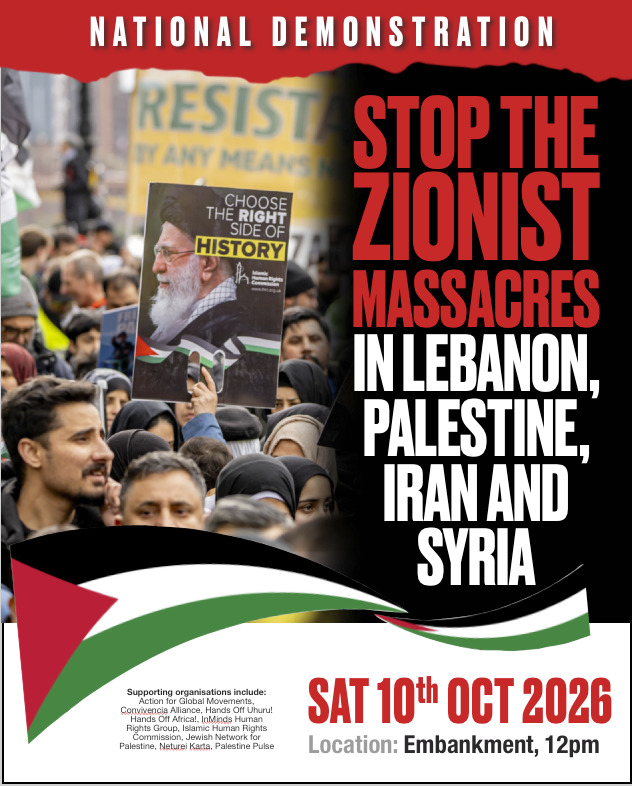
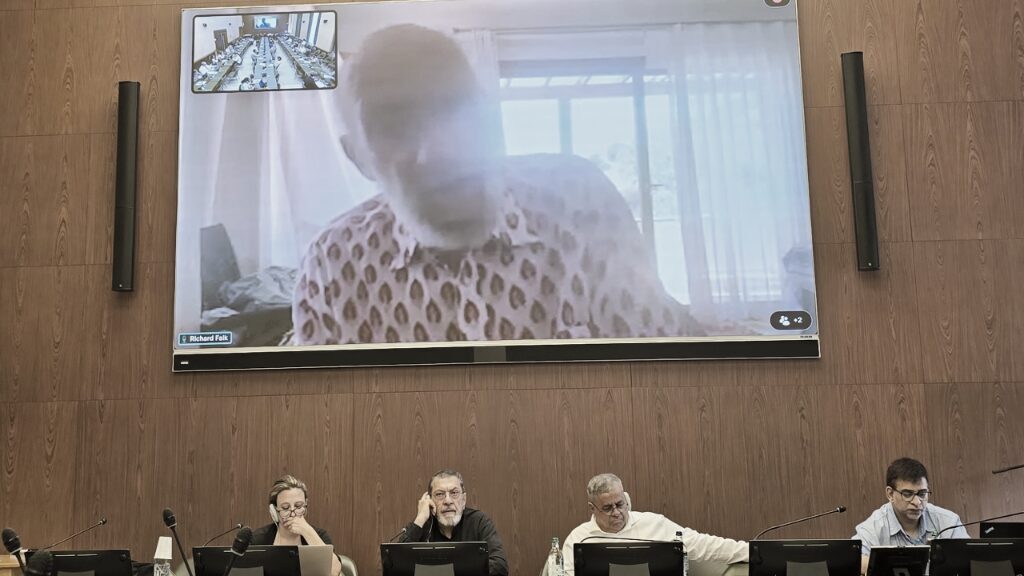
IHRC’s UN team organised a side panel on 1st July 2026 to discuss US Impunity on War Crimes, with Professor Richard Falk, Caterina Aiena and Sandew Hira. Watch the event, or read the transcript below the video.
Contents
Video of event (as livestreamed)
Event Details
This event was held on Wednesday 1st July at 12:00pm CEST, at the United Nations, Palais des Nations, Geneva, Room XI
The event was chaired by Massoud Shadjareh. Professor Richard Falk, Caterina Aiena and Sandew Hira spoke, followed by Q&A.
Transcript
Massoud Shadjareh:
Thank you very much for joining us today on this side panel. Unfortunately, the original title, which was supposed to be US Impunity on War Crimes, but it was decided to be changed by the UN authorities and the ‘US’ was taken off the title, but I think it’s very important that at this juncture of what it’s happening around the world, we actually address the elephant in the room and say what is taking place and how all the principles which we all adhere to within the international community vis a vis, supporting a moral principle and we should stand against war crime, we should always stand against abuses of all sorts especially at the time of conflict. We need to be able to articulate that and we need to call the elephant in the room.
We have got a very distinguished panel to sort of address these issues at the moment to join and be on the right side of the history because indeed what is at the stake right now after two years of genocide in Gaza, is that we all need to take that step and a stand on the right side of history because it’s not just about Gaza, it’s not about Lebanon or indeed the whole region. It’s about what is going to happen in the future of humanity and which side of morality do we want to stand on? Do we want to ignore the normalization of genocide as a tool or will we stand up against it and be willing to pay the price for that noble stand.
So without any delay, I just want to make sure that our our 1st speaker, is Professor Richard Folk, who is this international lawyer, professor of international law, and formerly a special rapporteur and he’s going to join us online.
So the floor is I’ll give the floor to Professor Falk.
Some technical issues
Richard Falk:
Thank you, thank you very much. I appreciated your introductory words which I most, ardently endorse: the genocide with impunity is a shame for not only the victims but also for the institutions, for the liberal democracies and for the UN itself.
The situation of accountability in international law has long been problematic. World War two ended with the winners designing a global normative order centered at the UN, but which exempted the most powerful countries from accountability under the UN Charter. That was made possible by giving the winners, of the the major winners of World War Two, a veto power and a permanent membership in the Security Council and various other privileged opportunities to either influence or obstruct the UN effectiveness. And that’s a matter of design. It’s not a matter of accident. The entrustment of global security generally, was given to these geopolitical actors, not to the international community, not necessarily to international law. This was reaffirmed in a certain indirect way by the war crime trials at the end of world War Two at Nuremberg and Tokyo, which only scrutinized the crimes of the losers never accepting any potential accountability or even scrutiny of such apparent criminality as the dropping of the atomic bombs on Hiroshima and nagasaki, as well as the strategic bombing of civilian centers of population concentration in both Germany and Japan.
So, accountability has always been geopolitically used as an instrument of punishing the losers and rewarding or privileging the winners. The outcome in Gaza has carried that dynamic to a further extreme in the Trump diplomacy, which not only gives Israel impunity, but essentially gives Israel (despite not being a winner in that sense of the war) a reward despite it being the perpetrator of the worst genocide since World War Two, and a transparent geneocide evident to the peoples of the world as it was occurring.
So there is a real challenge that hasn’t been met by the UN, in fact, the UN Security Council unanimously in resolution 2803 endorsed the Trump diplomacy of rewarding a perpetrator of genocide and further punishing or victimizing the target of that genocide. And I’m not sure what the political underpinning of that resolution was and why it acquired this unanimous support notably with the abstention of China and Russia, but still involving the UN in a very negative way. The further distortion of the attempts to impose accountability are evident in relation to the Iran war, where despite the aggression against Iran twice in a calendar year the aggressors are treated as if they are not accountable for that aggression and are entitled to participate as equals in the negotiation of an agreed ending to the war in the so called peace diplomacy.
This again negates a positive side of the Nuremburg experience which declared crimes against the peace or waging wars of aggression are the ultimate crime in international law. And this neglect of that Nuremberg Principle is accentuated in the mainstream western liberal democracies by speaking of it as a war of choice.
As if recourse to aggression is a matter of foreign policy. And that kind of attitude has undermined international law in relation to global security ever since 1945, but more dramatically since 7 October to 2023 and toward Iran subsequent to February 28th. This idea that a government has the option of choosing aggressive war, as a matter of foreign policy, is a real retreat from the effort to regulate the use of international force.
And it’s very regrettable that this has passed almost unnoticed within the UN and within the influential media platforms that inform public discourse.
And so although Israel has been delegitimized by the findings in part of the unlawfulness of what the International Court of Justice called a plausible genocide, and that has influenced civil society, it hasn’t registered effectively in international legal discourse, and that’s reinforced by the double standards or moral hypocrisy associated with condeming aggression when it was Russia attacked Ukraine, but ignoring the much worse criminality that Israel has perpetrated against Gaza, and Israel and the United States have perpetrated against Iran.
So this is a moment of challenge for the UN if it seeks to really bring to life the positive sides of accountability that that criminalized aggressive war and did not grant impunity just because you were the winner of a war and in the course of winning the war, committed grave crimes against the peace.
And my hope is that this sort of side event can raise these issues in a way that will at least bring them into the public discourse that must precede any kind of, rest restore restoration of effective procedures of accountability and the denial of impunity. Let me stop there.
Massoud Shadjareh:
Thank you very much, Professor for such a, important andtargeted speech with especially the request at the end of it. We are all hoping that this type of side event and these sorts of voices will be heard and bring a change, to their current environment which unfortunately is unfolding in the international community and indeed even at the UN despite the, effort of so many of us to highlight this. I mean we are all feeling frustrated and that it hasn’t happened yet, but we are hopeful that by pursuing and insisting we will see the environment change.
Our next speaker is Sandew Hira. He is secretary of the Decolonial International Network and a writer. I recommend his latest book to be read by all of you, Decolonizing the Mind. It really is one that should go on all of our reading lists without any delay. Sandew the floor is yours.
Sandew Hira:
Thank you very much.
My view of how to look at the impunity of genocide goes way beyond the Nuremberg trials because genocide was articulated in World War Two based on the experience of Nazism, but the global South has experienced genocide from the very start from 1492 when the genocide of the indigenous population took place in Abya Yala, formerly the Americas, where in three generations the total population declined from 100% to 5 %.
So millions of people have been murdered and killed and staffed long before the Nuremberg trials.
And then we have the genocide with the Transatlantic enslavement of people from Africa. We have the genocide that the Belgians committed in Congo by killing 10 million peoples just to collect rubber. So when we look at the impunity of genocide, then I propose to look at the institutional framework that enables genocide and that institutional framework is not, let’s say the non existence of international law. It is the existence of colonialism which basically instituted genocide as a instrument in the rule of of the global norm.
So my second point about impunity is that if you talk about impunity of genocide now, it is not only a system that generates, genocide. It’s also the question that so called non actors, non participants e.g. if you look at the genocide committed in Gaza, it is not just committed by Israel. It is not just committed by the support that the US gives to Israel. It is also the support that it gets from western countries. Even the support that it gets from Arab countries, Europe’s leadership.
So the impunity is impossible without the support that they are getting from all kinds of parties who are so called not involved in the genocide. But with their support, they have the silent cooperation in genocide.
When we talk about genocide, we, we shouldn’t talk only about the main perpetrator. We should talk about those who are supporting it.
And then the third aspect of why there is impunity in genocide is that there is also an intellectual environment that enables the perpetrators of genocide to continue. What I mean is that the media and the intellectual pundits both in the West and the westernized media in the global south, come up with the arguments for supporting the genocide and the arguments in the case of Israel and and Gaza is fighting terrorism, fighting Hamas, in Lebanon where there’s a genocide going on a smaller scale, [the argument] is fighting Hizbullah, and the attempt to wipe out Iran as Trump repeatedly said, is rationalized with intellectual arguments about getting rid of theocracy.
When I listened to Farid Zakaria at CNN, who is the proponent of liberalism in the west, I hear the arguments that basically are saying, first of all, he doesn’t use genocide in his terminology. And if you don’t use it, then you ask yourself, why don’t you use such an obvious thing of genocide? Why don’t you use the term? Because you don’t want to, inflict this label on basically a system that you support. So that’s why you don’t talk about genocide, but then you provide the arguments for the need to have a liberal ideology and a liberal system dominate the world as the road to freedom and basically use liberalism as an ideology to justify genocide, because the fight with Hamas and with Palestinian resistantce [according to this argument] is a fight for liberalism.
And then Israel is the torchbearer for liberalism, so there’s an ideological reason there for justifying genocide.
I would say this the last reason, and I was called that basically cowardice because those who are able to see what’s going on, who know what’s going on, but don’t have the courage to speak up against it.
And we have seen a lot of it, you know? But those who have the courage to speak against it, take the government of Spain or take the government of Ireland, and they come out with it. Obviously there’s a backlash, they know there’s a backlash, but they have the courage.
And those who don’t have the courage basically are accomplishing maintaining this genocide.
Massoud Shadjareh:
Thank you. Thank you very much, Sandew.
We are at a very strange sort of time after the continuation of genocide in Gaza, which is still continuing but is not on our TV screens anymore. It is sort of almost normalization to the extent that it does not really matter anymore. It’s finished, it’s done with and then what is happening in Lebanon and then what is happening in Iran right now as professor Richard Falk highlighted. I have to say that we all know that one of the reasons that genocide and war crimes are possible and tolerated and normalized is because of the demonization of a community prior to this geneocide and war crimes taking place.
And we have seen it. We have seen the preparation for Palestinians to be demonized to the extent that they are not part of the human race any longer. And we have seen the same thing has been happening in other parts, you know, what has happened with Iran.
I mean with the exception of sort of last few months that people are awakening and saying, you know, for God’s sake, why, why does Iran need to be subjected to this sort of barbaric attack, you know, children at the schools should be attacked at hospitals, bridges and even the articulation by Trump
that he is going to wipe out the civilization. Even then, it’s tolerable because of the level of demonization that has taken place and the rest of us, the society as a whole, is sort of turning the blind eye to this process and allowing it to take place.
Look, we as an NGO, and I know many others and many other people who have been voicing concern for this issue of trying to stop this level of demonization, have been working hard, but obviously we haven’t been successful in convincing the international community and even the UN itself that this needs to be much more prominent as a battle for stopping this because you know once the genocide takes place, it’s very difficult to stop, but we could stop it before the legitimization of it before: we could stop this process of demonization, and we know in the history never genocide has taken place without this element of demonization and preparation for genocide to take place.
I would like to sort of move now to Caterina. Caterina is the policy officer at the Islamic Human Rights Commission and she’s one of our prominent reporters.
The floor is yours.
Caterina Aiena:
Thank you. Good morning, everyone. So I would like to start with a simple question which is connected to the what has has been said, what happens when accountability becomes selective? This is no longer merely a theoretical question. It reflects a growing concern about the current state of the international legal order.
And this is not only question about Iran or Israel or Venezuela or anywhere else. It is a question about the credibility of an international law itself.
Today, indeed, the international legal framework appears more fragile than ever. The recent military escalation involving Israel, the United States and the Iran cannot be viewed therefore as an isolated episode rather it forms parts of the broader pattern that raises an important question about the effectiveness and the consistency of the international legal system and the democratic structure of our society.
Over the past few years international accountability mechanisms have increasingly become more object of a political contestation, The international criminal court has faced political pressure and sanctions, the United Nations mechanisms is more frequently disregarded when the findings become politically inconvenient. International judicial institutions are often challenged less because of their legal reasoning, than because of the identity of those they investigate.
At the same time we are we are witnessing a broader democratic progression restriction on peaceful protest have expanded. Cou nter terrorism legislation have been used beyond its original proposal to regulate political descent and journalists human rights defenders and lawyers working political sensitive case have a faced growing pressure. This development should not be viewed in isolation again when international accountability mechanisms become less effective or less independent, the broader commitment to the rule of law is weakened.
The result is not only crisis of international justice but also gradual erosion of democratic safeguards at the domestic level.
Against this backdrop IHRC research initiative seeks to make a practical contribution to the future accountability efforts, and then I would like to conclude by presenting IHRC forthcoming research efforts consisting on collecting, preserving and analyzing information related to the alleged violations of international humanitarian law committed during the recent conflict in Iran. Our objective is not only to reach legal conclusion but to contribute to the preservation of reliable evidence and may support future investigation by domestic court, international tribunals or United Nations mechanisms.
This will be done by collecting and verifying the evidence we found on the ground. E factual record should identify whatever possible the precise location of the incidents, the dates, time and the victim affected and their numbers. The […] employed and the source supporting the account, everything corroborated by pictures, witness, testimonies, and or official documentation.
The research scope firstly is focused on the use of force itself. Article 2.4 of the United Nation Charter prohibits the threat or use of force against the territorial integrity or political independence of another state outside security council authorization, as has already said that only recognized exception is the imporant right to self-defense, which requires necessity, proportionality and existence of an armed attack.
But a growing number of international law scholars together with the United Nations special rapporteurs and independent experts have a question whether this legal requirement was satisfied in the relation to the military operation conducted against Iran, arguing that the attacks raise several concerns under the UN charter and risk further weakening one of the fundamental principles of the post war international order.
However, the legality of the resort to the force is not only one aspect of the issue.
Once an armed conflict exists, international humanitarian law governs the conduct of hostilities. The core principles are were established distinction between civilians and competence, proportionality in the use of force, the obligation to take all feasible means to minimize civilian harms. In Iran, this has just happened and clearly needs independent investigation and international humanitarian law, including attack affecting hospitals, schools, detentions, houses. For this reason I would like to conclude by inviting and if you could help us to share the invitation and spread an invitation as well.
Anyone researcher, lawyer journalists, human rights defenders, a member of the civil society with access to real good information to get in touch with IHRC research team to contribute to these efforts.
Thank you.
Massoud Shadjareh:
Thank you very much Caterina, and, this this request is to the whole of the civil society and indeed beyond that we need to record at the moment the reality of what is happening in in Iran and and so we could take further steps in the future. We can’t really allow the status quo to continue.
I think one thing which was shared between all the contributors today is the fact that this environment, the current poisonous environment, which has allowed us to sleep walk into an arena where heads of governments brag about committing genocide. They actually legitimize genocide. They try to explain that the necessity of committing genocide.
It really is incredible. I always say that, yaround 20 years ago, if somebody came to me and said that we are going to lead to where we are right now, what happened in Gaza and what is happening and so forth, I would have said that, you know, it’s impossible. I would have thought that there are being conspiracy theorits and they are being too extreme and too negative.
As a matter of fact,I myself was being called too negative and now I think that I’ve been too optimistic, because the reality of what is happening is much worse than what we all thought would happen.
And it really is incredible. I think those of us in the civil society responsibility and and those of us who are structured into human rights organizations and who are involved in civil society at the UN and other places around the world internationally: This is happening at our time, and we need to highlight this to the UN, this is happening on our watch. We are supposed to be the of champions of trying to stop this sort of thing happening.
And what are we gonna do about it? How are we going to stand up? Yes, of course, it goes without saying that we have heroes both outside the UN and inside UN structures who are paying a huge price for speaking out. Really, I have to take my hat off to those judges in the international courts who are being sanctioned. Those special rapporteurs who are being sanctioned and their life made miserable.
They can’t even have bank accounts and they can’t even function in the most basic way, but they’re still standing on the right side of history and they’re paying the price. And indeed many human rights advocates are paying this price, and we are all willing to pay those prices because we know how important it is, how essential it is to actually make that choice.
We have made that choice the minute that we stood up to be human rights advocates. We stood up to preserve civil society and the future of humanity. So we are paying willing to pay that, but it needs to go much further. We need to change the environment as a whole and we need to move forward.
I would like to open up the floor for questions and answers. Please if you be brief so we could get as many questions answered.
Thank you.
Question 1:
Hello. Sharof Azizov, Justice pour Tous Internationale (JPTi).
My question is about UPR that United States skipped last year in November and I’m just wondering what do you think in your view, the United States was rescheduled for review under the UPR this November during the 53rd session of the working group on UPR. In your view, do you think that the Human Rights Council should proceed without presence of the US delegations this time or they should, still wait and postpone maybe for the next cycle.
Thank you.
Massoud Shadjareh:
I think you know we are seeing some sort of attempt to exceptionalize certain countries from being accountable and UPR is one of those and US is one of those countries, and I think UN needs to make sure that that privilege is not given to anyone at the UN and the you know and and governments as much as theUN diplomacy needs to be adhered to, I think accountability is extremely important at a time like this.
And if we are gonna make exceptionalism and not hold US or any other government accountable, then it really becomes a continuation of impunity to commit these crimes and be and not be hold accountable. So in short, I, I think it’s essential now, especially after last year that this needs to move forward and the US or any other government be told that the UN will not give him any exceptional sort of impunity for what they commit.
Any other question?
Question 2:
I’m from Liberation Scotland. You mentioned that we cannot allow this to continue. There has been a long term discrepancy in terms of the application of law to the weak states or to the strong states. And you spoke about how civil society and non state actors must now take action to prevent this from becoming worse or from being allowed to continue.
I wondered if you had any practical strategies, actions that you felt that we should be taking, that should be being taken in order to achieve that. Thank you.
Sandew Hira:
Yes, thank you. I think what we have seen in the last two years with the Gaza genocide, that if it were not for the students in the streets and in the universities and social civil society mobilizing, then Israel would not have been held accountable as it is now. So we should learn from the fact that people have the courage to stand up. And I think the question of courage is very important that we need to mobilize and organize with the perspective that it is part of a struggle which can have a backlash on you and your personal life. And you will and should be able to take it up and say we, we accept the backlash, and build on the ground movements that hold government accountable because if only you talk to governments and social movements are not involved, the government doesn’t listen. But when people go out in the street and they occupy buildings and they mobilize and that is what made Israel now a criminal in the eyes of the whole world. It’s not because governments did it.
So I would say, let’s learn from the lessons of the past two years of mainly young people who have taken up to challenge power and speak to power so that we don’t think it’s only a question of resolutions that, you know, international institutions can take. In fact, they even don’t dare to take those resolutions and it is what I think where we need to go now is make certain that the movement on the ground acknowledges that when you talk about Palestine, you just don’t talk about the genocide and Gaza. You need to talk about the genocide in Lebanon. You need to talk about the attack of Iran and because both Hizbullah and Iran have been criminalized, even on the basis of the social movements, there’s some hesitance to engage in dialogue with forces, you might have different ideologies, you might have different ideas.
but the alternative to war is dialogue. The alternative to war is not silence. And I think the good thing that they did on the ground of mobilization against the genocide in Gaza. So they need to take it a step forward and say, we want to have a dialogue with those forces who now are part of the axis of resistance.
Caterina Aiena:
Yeah. I mean civil society cannot do just reporting and documenting human rights violation, complaining, and that’s what IHRC has done e.g., I work on another report on Governmental Crackdown on the Palestine movement in Europe and when we’ve done the research, we were one of the first organizations doing that after the publishing of this report a lot of other reports came up and they have documented and they cannot longer be cancelled.
The level of violation that we had in Europe as course at the office in in public space. And this means that, this is my particular reflection, I don’t believe that today crisis is a lack of legal instrument. We have an extra extraordinary body of international law and the legal. The the legal framework now protects almost every dimension of human life. We have right to life, right to health, citizenship, political participation, freedom expression, we have protection f civilian, prohibition of torture.
I think what happened appears to be lacking is the capacity to ensure that these rules are applied consistently and effectively. And this is our role for what we can do. I mean, it would be for sure one of the greatest challenge for the next generation for us to build an international system capable of ensuring genuine accountability without credible accountability, even the strongest legal framework risk becoming ineffective.
Question 3:
Thank you. Talking about the public awareness creating general everything has been done, and at the end of the day when we talk about accountability there are institutions, there is everything, but it’s at the end of the day, those institutions who have to make the states accountable for it. And I think from last two years experience or in the past also we have seen that these calls for accountability when civil society calls for accountability or institutionals call is for accountability and they are not in a position to implement that threatens the prosecution sometimes and the conflict prolongs and then they are they are removing these calls or removing the incentive for any negotiation. Because we are neither in the negotiation, we are just creating a pressure, but when we create the pressure, everything, those institutions are silent, they cannot make any accountable accountability system or they can’t make they don’t dare to make any thing for that. And then the room for negotiations between the parties that also lapses over there.
Massoud Shadjareh:
Sorry, very good point and and if I may sort of add to say yes, we do have the laws and and principles to be adhered to and we have seen that to be undermined and our report recently very clearly highlighted and that the way that in the west, in particular France, Germany and Britain, how national or international commitments were undermined towards those who are standing in support of Palestinians or and challenging genocide, how they are being targeted as terrorists, how they have been harassed day in, day out. These things are happening, and it’s not just in one part of the west. This is happening everywhere. It’s happening in the United States, it’s happening everywhere, it’s happening even in some Arab countries, you know, and and that has to change. Yes, we do need to highlight that yes we do need do reports as we have done and and the impact of it on special rapporteurs. These are some small victories, but it’s not enough. We need to do a lot more and pay the price. I keep on saying be willing to pay the price because it does mean there is a price to pay, you know.
Even I myself when I was entering Switzerland the yesterday. I was questioned for quite some time , a British passport holder, you know and you know this this has become new reality for those of us who are standing on the right side of the history and and trying to hold accountable those who are undermining our laws and regulations. In short, I would say to our colleague who asked the question, we need to do all which was suggested here and so support those who civil society and so forth who are standing up, but what we need to also do for better world, we need to decolonize the international institutions because there is this exceptionalism and and the colonial or neo-colonial states think they could get away with murder and indeed they are.
So we need to do that. It will be it’s totally unacceptable that international judges are being treated in that way, it’s totally unacceptable that special rapporteurs are being treated in the way they have been treated and indeed this goes all the way down to ordinary civil society. So together we could do that but as as someone who’s always hopeful even in the most difficult time of our lives, I’m hopeful together we could do it, and we should not give up. We should not despair.
Thank you for coming to this side panel, let us work together for a better future, not just for ourselves, but our next generation. Thank you very much indeed.
Event Notice
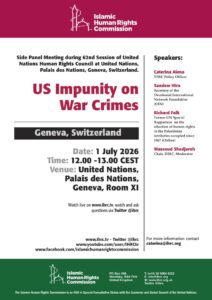
Join the IHRC’s UN team for the UN side panel on ‘US Impunity on War Crimes’
When: Wednesday 1st July at 12:00pm CEST
Where: United Nations, Palais des Nations, Geneva, Room XI
Join us in-person or online at ihrc.tv or YouTube
You can send in your questions by replying to our tweet here.